The Allplane Podcast #140: electric aviation infrastructure w/Dr. Stefan Breunig (Albatross)
The path towards electric aviation is not an easy one. On this podcast we have talked on previous occasions about some of the challenges it faces, from getting batteries with enough energy density to setting up a supply chain from scratch.
One area we have so far - until now, at least! - paid little attention to is that of ground infrastructure.
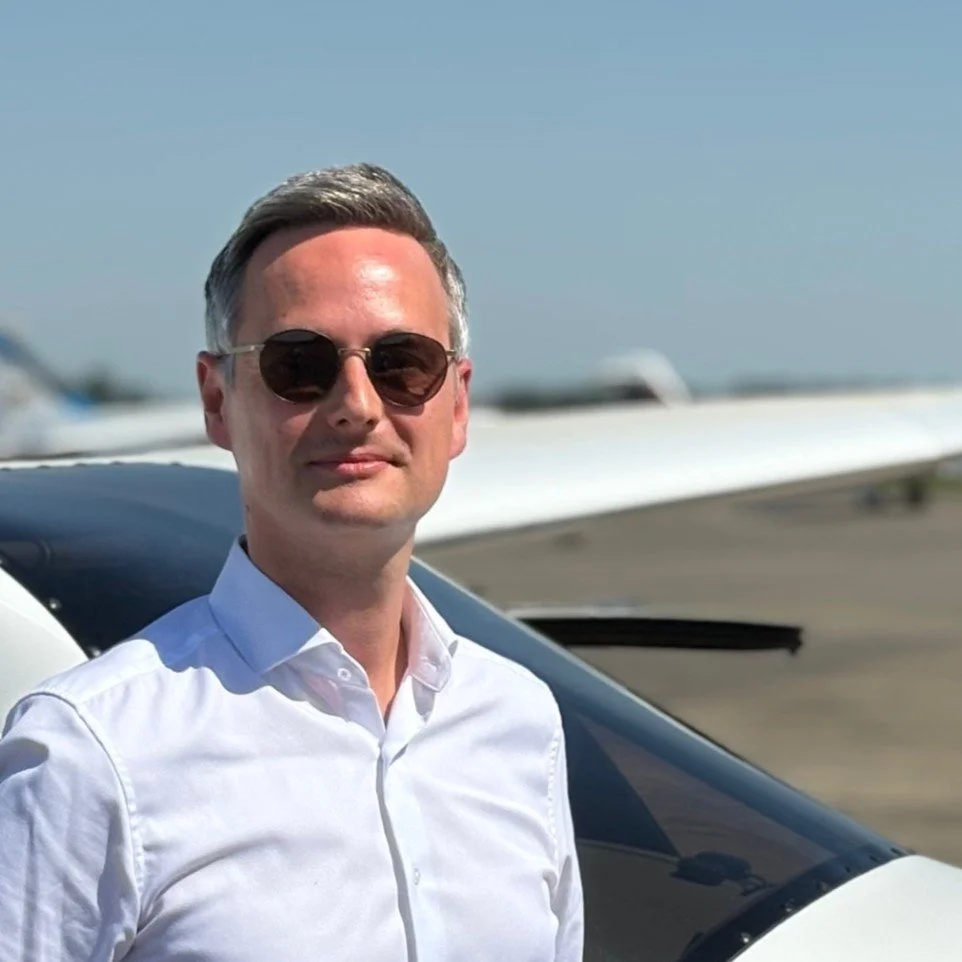
Our guest for this episode, Dr. Stefan Breunig, is the co-founder and managing director of Albatross, a German company that is working precisely in this space.
The electric aviation revolution will need to get supplied by a reliable stream of green electricity, but it also represents an opportunity for airports and other players in the aviation ecosystem to develop new lines of business which stretch well beyond aviation.
Can airports become green electricity hubs? What are the challenges the industry faces on this front, in Germany and elsewhere?
Tune in for a fascinating conversation with one of Europe’s top electric aviation experts!
Things we talk about in this episode
Stefan’s professional background and his work across the electric propulsion industry
Why having the right infrastructure on the ground is key for the development of electric aviation
What was the original mission of Albatross and why the company pivoted shortly after
Can airports become green electricity hubs?
Which challenges faces the electric aviation industry in its rollout
Which are the most promising paths forward for the electric aviation industry
Resources
Dr. Stefan Breunig on Linkedin
The e-Fan and its remarkable Channel crossing (the joint electric aircraft project of Airbus and Siemens)
Aeroscopia, the aviation museum in Toulouse where the e-Fan is now exhibited
The Pipistrel Velis Electro and the podcast episode we did with Ivo Boscarol, the company’s founder
e-Flight challenge and the podcast episode we did with its promoter, Morell Westermann
Nuremberg Airport, which has a large photovoltaic installation
The vertical photovoltaic plant at Frankfurt Airport
The structure of electricity distribution in Germany
A map of the Holy Roman Empire, which, during our conversation, we compare to the electricity distribution structure in Germany
Some of the companies mentioned in this episode:
Magnus, the Hungarian aircraft maker
Rolls-Royce and when it decided to leave electric aviation
H55 and the podcast episode with its founder, André Borschberg
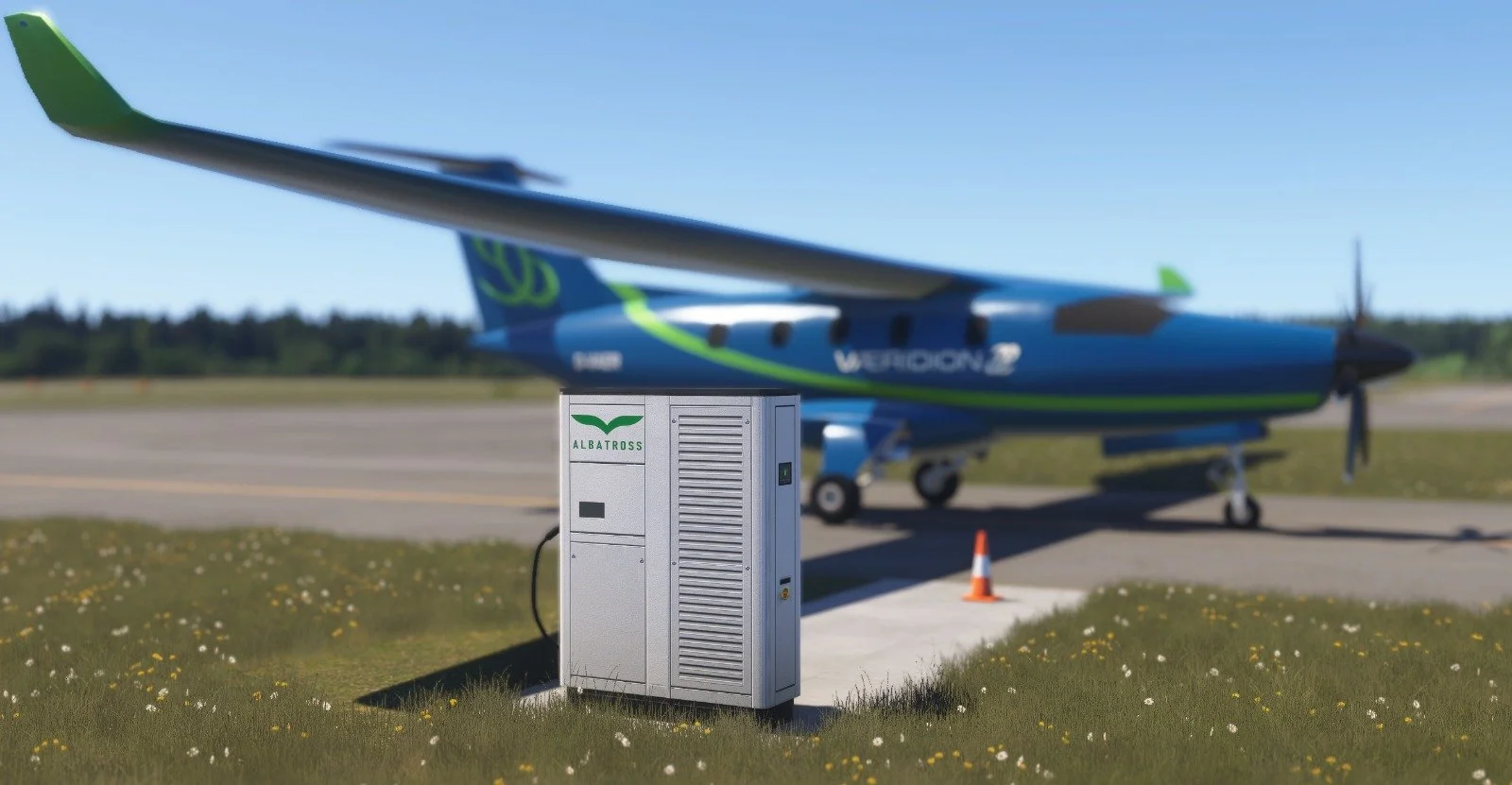
In the picture below, besides one of the chargers in Albtatross logo you can see a rendering of a Vaeridion microliner, which we talk about in our chat with Stefan. You can also listen to our podcast episode with Vaeridion founder and CEO Ivor van Dartel.
Podcast Music: Five Armies by Kevin MacLeod
Link: https://incompetech.filmmusic.io/song/3762-five-armies
License: http://creativecommons.org/licenses/by/4.0/
Interview Transcript:
(please note that, although we strive to make it as close as possible to the original recording, the transcript may not be 100% accurate)
- Hi, Stefan. How are you?
- Hey, I'm very fine. I'm really happy to be here.
- Likewise, great to have you here. I think we've been trying to find a time for this podcast for quite a while. You guys at Albatros have been working in electric aviation for quite some time, and we're going to talk about what you're doing and about the general outlook for electric aviation, mostly in Europe, though we can also talk about the global landscape. First of all, like every other guest, I would like you to introduce yourself in a few words and tell us a little about your background, because you've had quite interesting experience at Siemens and then at Rolls-Royce, working on electric aviation projects, right? So tell us about yourself and how you got involved with Albatros.
- Yeah, thank you, I'm happy to do so. First of all, I'm a really big fan of your podcast, so I was really excited to come on it. And that's also because of my background: I've been listening to everything involving electric aviation in previous podcasts or news.
- Thanks for the kind words. We try to get a few guests in electric aviation, and I'm sure you know some of them pretty well. We've had VÆRIDION, we've had Eve, the eVTOL developer, quite a few companies that are active in this field. It's a small ecosystem.
- Whenever you go to Farnborough, Paris or ILA, it's always a little bit like a class reunion, right? And I was very fortunate: I entered this ecosystem in 2017. I'm a mechanical engineer by training, and I did my PhD in innovation and technology management.
- You're a real pioneer. In 2017, I think very few people were talking about sustainable aviation, let alone electric aviation.
- Yeah, and this was actually a really interesting story. I was hosting a course on innovation and technology management for executives, and one of the participants, who became a very dear colleague, introduced himself and said: "Well, I'm leading a team of 100 people at Siemens that we're just building up, and we're going to work with Airbus on electric aircraft." And I was like: "Wow, that sounds very interesting." At that point, I was mainly working on electric cars with the German automotive and machinery industries, and that got me really excited. So I think one week after that course, I sent him my application, and a couple of weeks later I got my contract with Siemens.
- You're an engineer by background, right?
- I'm an engineer by background, yeah, mechanical engineering, but I always focused on the business and strategic side of it. And well, he brought me in, and actually, the first thing he told me was: the job you applied for is already gone, but I have a new one. I want you to introduce everything you taught in innovation and technology management into the new unit we're building. So I was able to work on topics like technology roadmapping, technology scouting, how we address this new market. Though it wasn't really a market back then. It was still really early technology development and aircraft studies, which we mainly did together with Airbus.
- Yeah, I remember there were even some demonstration stunts. I think a flight across the Channel, I think that was…
- Yeah, there were the really early innovation activities, like the E-Fan, which flew across the Channel.
- Yeah, I think that airplane is now at the Aeroscopia museum in Toulouse.
- Yeah, yeah, it is. Real pioneering. I think that was around 2014.
- Okay, so even earlier than when you joined.
- Even earlier. But when I joined Siemens, actually back in 2016, Siemens broke the world speed record for an electric aircraft in multiple categories with the Extra 330LE, which was really exciting, with a 260-kilowatt motor. And all the time I worked at Siemens, we did a lot of flight testing. We had a unit in Budapest with an incredible team and close access to an airfield. We had three aircraft from Magnus, a small Hungarian airframer, and we were able to do a lot of testing with an all-electric powertrain, with swappable batteries, with a diesel hybrid. So a lot of early testing of technologies, and that was really exciting. And actually, in my second week at Siemens, in September 2017, I was able to fly in an electric aircraft with our CEO at the time, Frank Anton. Shout-out to him; he's also a real pioneer in the field.
- There's a bit of a Wright brothers feel about all this, what you're telling me.
- Yeah, it was really exciting. I remember standing on the runway in Oberpfaffenhofen, close to Munich, and there was some wind coming up, and the propeller was spinning the other way. And I was like: "Hey, are we regenerating now?" Which wasn't possible at the time, and it's still not possible with certified aircraft, because there is no certification basis for regeneration. But nonetheless, it was really, really motivating and exciting. And then it was quite some time before, last year, I flew in an electric aircraft a second and a third time. So that shows you how early we were at Siemens in getting those aircraft into the air.
- Which aircraft was it?
- Last year, well, the Pipistrel Velis, which was long overdue for me to fly in, and the Elektra Solar Elektra Trainer, from Landsberg, close to Munich, a certified ultralight with an endurance of three hours. That was also really nice.
- Yeah, I had the chance to see this Elektra Solar aircraft up close. I think it was two or three years ago, when we did this challenge with Morell Westermann, who has been a guest on the podcast. He organized a kind of rally across Germany between an Elektra Solar electric aircraft and a Lucid electric car, all the way from Bavaria to the North Sea, and that was also pretty cool. And I think the aircraft managed to do it with two or three stops. I'd need to check now, but it was about 800 kilometers.
- Yeah, the aircraft offers quite a step in terms of endurance, also because it's basically a glider. It has a really good L/D, and that makes it quite special.
- And then you went to Rolls-Royce, right?
- Yes, exactly. In 2019, we had great achievements in this collaboration with Airbus, with the CityAirbus, which was the heaviest eVTOL at the time, and we started flight testing it in 2019.
- Yeah.
- That was really exciting. But Siemens… well, it was a time of transformation. Siemens is always in some kind of transformation, but at that time they started to split the group into different areas, and they asked themselves: is aerospace an area where we want to be in the future? And the answer was no. So we were tasked with finding a new home for our unit of around 200 engineers, and we found it at Rolls-Royce. At the time, that was a really good move, because there was already a small electrical team at Rolls-Royce, and we brought almost 200 engineers over from Siemens and really accelerated the electrification story at Rolls-Royce.
- Yeah, unfortunately, after a few years working on electric, Rolls-Royce also decided it was not core business, and they basically closed it down, or spun it off, I don't remember. Did anyone else buy that part of the business, or did they just close it down?
- Yeah, now you're jumping to the end of the second part, which is a little similar to Siemens. It was also a transformation within the group. So maybe let me take one step back. When I joined Rolls-Royce, I assumed responsibility for the strategy of the electrification division, Rolls-Royce Electrical. Technology was still a big focus, but so was the question of what the markets are, what the market potential is, and what the business cases are for the products we could bring into this propulsion market. So it was really focused on developing these markets, and we had great success in securing key customers in UAM and eVTOL, but also regional air mobility customers. And something that may not be that obvious to the public is that we did a lot of work bringing electrical technologies to the other businesses: defense, business aviation, stationary energy systems.
- Just one parenthesis here, because you mentioned UAM, as a clarification for anyone who doesn't know the acronym: urban air mobility. So basically, that would include all the short-haul eVTOLs and other vehicles designed to move over short ranges, mostly in cities. But I think this acronym has fallen a bit out of use, in favor of advanced air mobility or regional air mobility, which are a bit more flexible, at least in their definition.
- Yeah. Well, I worked in strategy, so I did the market segmentation and everything. Everyone does it slightly differently, right? EASA defines it a little differently from NASA. I think one very commonly used definition is advanced air mobility as a headline, summarizing these new forms of electric, hybrid and novel mobility solutions. And I would divide AAM, advanced air mobility, starting with UAVs, unmanned aerial vehicles, drones, right, that are unmanned. Then the eVTOL segment…
- Yeah.
- …which is quite often used synonymously with UAM, but people quickly realized it's not just going to be urban; they're going to fly further. So, the eVTOL segment, and then regional air mobility, with fixed-wing aircraft of up to 19 seats. So for me, and I think this is the definition with the biggest consensus, it's everything from drones flying without passengers up to 19 seats. You can also argue that larger aircraft could be advanced air mobility, but typically that's the definition. It's also what NASA uses.
- Yes, and it's also a little difficult for the startups that are redefining the segment to work on larger aircraft. It's a big step up in the capital requirements and the capabilities required. So you were at Rolls-Royce, and Rolls-Royce actually had a very interesting program to develop electric engines and electric motors. I remember visiting the plant in Dahlewitz, near Berlin, where they showed us the work they were doing. And then, unfortunately, there was this change in strategy, and they decided electric was no longer on the roadmap.
- Yeah, that happened. A bit of déjà vu, coming from Siemens. The broader context is that after COVID, and with the Trent 1000 issues, Rolls-Royce was in a financially unsustainable situation, I would say. The new CEO, Tufan Erginbilgiç, who joined in 2023, started a complete strategy assessment of the group, which I was part of, and then, as a result of this strategic review, a transformation of the group. In November 2023, they announced the core markets. The core markets will be large gas turbines, business aviation, defense, and power systems for governmental and stationary use.
A lot of other fields were put into, let's say, the divest-and-exit bucket, or the partner bucket, where they were aiming for partnerships. And it was communicated to the market that advanced air mobility was seen as a non-core market. The way to deal with the unit was to have advanced air mobility as one unit and try to bring it into a partnership that would make it commercially successful, but take it off the Rolls-Royce balance sheet, right? That was more or less what was communicated externally, and I can't go into any details. Of course, I was also working on M&A; that was mainly what I was doing in my last two years at Rolls-Royce.
- So you had a front-row view of what was going on.
- Yeah. But what was communicated is that, in the end, they didn't succeed in securing that partner and that future, and Rolls-Royce focused on its core. So the decision was to shut down the AAM business. But at the time, AAM was one big part, with all the market segments we talked about, and as part of Electrical there were also all the activities supporting the other businesses, and those remain in the group. So electrification, more-electric engines for business jets, business aviation, anything that supports defense programs, because there is a…
- When you say more-electric engines, you mean that some of the functions, some of the mechanisms inside a conventional thermal engine, might be driven by electricity?
- Exactly. For business aviation engines, this could mean replacing a pneumatic starter with an electric starter, which helps improve the design. You can also reduce fuel consumption. So there are a lot of areas where additional electrification brings benefits to gas turbines. And for defense, there's also a requirement for more electrical power on defense platforms, on different types of aircraft, so electrical generators are also an important building block there. These activities have remained within Rolls-Royce. So Rolls-Royce has not stopped electrification completely, but it has stopped focusing on these new market segments, which, quite frankly, are quite far from its core market segments, which are large wide-body aircraft and big high-performance business jets.
- Yeah, and if you look at the gigantic size of those other markets, it's a really small part. Even if it's valuable, it's almost a small footnote. The idea is that it will grow eventually, but at the moment it's a relatively small part. And electric remains a bit the preserve of dedicated electric-centric startups. We've mentioned VÆRIDION, which is based in Germany, and which I know you know very well, because you've been collaborating on projects. And there are other companies, like Elfly in Norway, Electron in the Netherlands, and in the US as well, there are a few. Hybrid-electric is also a thing. So I guess there's this idea that electric is eventually making progress and is going to happen, and if not through main players like Siemens and Rolls-Royce, then other players are going to bring it to market. And then I guess that's what took you to your next step, which was establishing Albatros, right?
- Yeah.
- What can you tell us about Albatros? Because I think you've also been refining your approach, what you're trying to do.
- Yeah, there have also been some headwinds in this business. Already during my time at Rolls-Royce, I was focusing on the broader ecosystem. For example, we had a collaboration with Skyports, to bring together our knowledge of maintenance and infrastructure with vertiports. There, I brought in the Rolls-Royce Power Systems division, which does microgrids and large battery systems, so we could bring that together. Because even at the time, many customers were asking:
"Hey, Rolls-Royce, you're providing the engines and the batteries. We want to understand what maintenance is going to look like, and what the infrastructure to support these aircraft is going to look like."
That's why I looked at those topics quite early, and this brought me to vertiports, hence my collaboration with Skyports, which is a great team that I really like, and also to early collaborations with airports. And I saw that they were all excited. They wanted to be part of this future, but it was very difficult for them to judge: okay, when are these aircraft coming, what will the requirements be, and how do we get started? I was never really able to solve this at Rolls-Royce, because our core focus was building propulsion systems, not developing the entire ecosystem. But when I left Rolls-Royce, I met some colleagues who then became my co-founders.
One of them, Andreas Kupke, has also invested in VÆRIDION and other electric aircraft companies and is really pushing this ecosystem, and he had already started working on Albatros. He was the initiator, because he saw that there were great companies like VÆRIDION working on the aircraft, but who was preparing the ecosystem? So he toured all the regional airports, had a lot of talks, and developed the overall concept together with key airports. And then I met him, and it was like: hey, I've also been looking into this topic for quite some time. So together we started Albatros.
- Well, I think this would be a good point to explain what you're doing.
- Yeah, exactly.
- We can say you're an integrated infrastructure company. So basically, you are helping develop the ground infrastructure that will be necessary to kick off this electric aviation revolution, right?
- Yeah, exactly.
- And that can mean different types of interventions at airports. Things people kind of take for granted, but which are not at all in place right now, if electric aviation is to be a reality. That means connection to the grid, managing the power supply, generating electricity, because some airports can also become centers of electricity generation, storing that energy, and basically all the related hardware you need to have in place to distribute this electricity. And I think that's particularly relevant for many of the small airports, which is where most of the promise of electric aviation lies. Because I think it's safe to say that, at least for a few years, electric aviation is not really a replacement for the mainstream airlines we fly with now, but more a replacement for, or a complement to, things like flight schools and regional air travel, which opens some interesting opportunities we can discuss now, and other types of missions conducted by small aircraft, which are the ones most likely to electrify first, I think.
- No, well, you've just made the perfect pitch for our vision and what we want to support. It starts with enabling electric flight. That's what drives us, and what has driven me since 2017. But with Albatros, we also took a bit of a broader vision. The vision is to transform regional airports and airfields into energy, mobility and logistics hubs, to really develop these assets that are there. We have a very dense network of airfields in Germany and in Europe, in Germany in particular, but also France and Italy.
There are a lot of regional airports and airfields, and they are typically underutilized, and often in financial distress too. But they have a great opportunity with electric flight, and with some other topics as well. So what we're doing is working with them on energy projects: PV energy production on site, photovoltaics on rooftops and surface areas. You have large surface areas at airports and airfields, and you can use them. There are some things you have to take into consideration when building PV at an airfield, with glint and glare and other compatibility topics, but it is something standard you can do. You can build battery storage there, which enables new business cases for the airport, and which can then, as a next step, support charging infrastructure.
- I was at Nuremberg Airport earlier this year, at the photovoltaic installation they have there. It's pretty impressive. They derive a significant amount of the energy they use locally at the airport from that solar plant. I don't remember the exact number now, but I think it was in the double digits, for a relatively large airport, because Nuremberg Airport has a few million passengers going through every year.
- Yeah, absolutely. We see this at Frankfurt Airport too, which is very interesting. They installed a vertical PV field, so there are rows of vertical PV modules.
- What is vertical PV? Is it in the facade of the buildings?
- Not in the facade, but next to the runway, next to the south runway. They're installed vertically. It's like a fence, more or less, and it could be in multiple rows at a certain distance.
- But is it angled?
- No, it's really completely vertical, and it doesn't move. There is almost no impact from glint and glare on landing aircraft, and it's also quite attractive to get the early morning sun and the evening sun, because that helps you with the profile. If you have perfectly south-facing PV, it produces a lot of electricity during the day, when the sun is at its highest point. Typically, that's when there's too much electricity in the grid and the prices are really low. So there are different arrangements of solar panels now in use, and at airports, vertical arrangements are one option. Frankfurt, for example, is doing that. Nuremberg has an east-west configuration, which is also really good to support the airport's energy consumption. If you look at all the big airports, they're doing this, because they can lower their electricity bill.
- Yeah. Even in Svalbard, up north in the Arctic, way north of the Arctic Circle, I did an article for CNN about the work they are doing at Svalbard Airport to make it more sustainable, and they were also experimenting with solar energy. Which is interesting, because they have six months of total darkness, but of course they also have six months of, well, not total, but many hours of daylight. So it kind of compensates on a yearly basis.
- For 50% of the time, it's an amazing business case.
- Yeah.
- So, coming back to what we do at Albatros: our vision is to really think of an airport as an integrated system that can produce energy, store energy, move it around, and then also provide it in the form of charging infrastructure to local companies, and really become this energy hub. Now, on the charging infrastructure side, of course there are electric vehicles, but in the short term there are also electric trucks. That's quite a big topic in Germany right now. I'm currently working with a couple of airports to access German government funding for truck charging sites, because if they're next to the autobahn, next to a highway, they're really good locations for truck charging, for example.
- Trucks that might be just passing through, not trucks working at the airport?
- Yeah, exactly. Logistics trucks that would drive off and charge there, and the benefit is that it's a source of income for the airport.
- Yeah.
- Someone else would operate it, but the airport would get, for example, a revenue share.
- Electrification of ground support equipment has been a theme in the industry for quite some time, which makes sense, because that equipment operates within a relatively small perimeter. So it should be easy to charge them and have them move around.
- Absolutely. There are a lot of opportunities. I would separate it into landside and airside. On the landside, there are EVs and trucks. And you might say: well, how does starting with truck charging help the airport become ready for electric aircraft? I would say, first of all, it's a source of income, and that helps the airport. But also, when you do the grid upgrades and install the charging infrastructure, that will also benefit the charging infrastructure on the airside, if you do it in a smart way. Not the chargers themselves; it's not that you're handing them over from airside to landside. But the electrical infrastructure behind them will put the airport in a better position to then install megawatt-level charging on the airside. And on the airside, yes, GSE is a big topic.
Typically, you can use AC, alternating current chargers, at relatively low power, for example to charge the equipment overnight. But then you have electric aircraft coming, from small trainer aircraft all the way up to the VÆRIDION Microliner, which will use MCS, the megawatt charging system, so megawatt levels of power. This requires not only the chargers themselves, but also upgrades to the energy system, because the airfields and regional airports best suited to be nodes in a regional air mobility network definitely don't have the power and energy available today to support megawatt-level charging. So they need to start preparing today.
- So it's a matter of investing in a more robust electrical infrastructure on the ground.
- Yeah, absolutely. And it makes sense to start today with PV. If you look at different airfields on Google Maps, maybe you've done that, I've done it quite a lot, you often…
- But not as a standalone hobby.
- Yeah, no, maybe I do it as a standalone hobby. Quite often, there is already PV installed on hangars, but typically everything is fed into the grid, right? It's not used locally. They have 20-year contracts to feed it into the grid, because that was very attractive over the past 20 years, with a lot of subsidies. That's gone; it's not the case anymore. So what airports and airfields should do now is start building PV on hangars for their own consumption, and they should do this in conjunction with charging infrastructure, because a standard hangar typically doesn't have a big energy requirement. It's a good opportunity to scale up PV now, with initial charging infrastructure for EVs and ground support equipment, and initial batteries that can maybe also do energy trading on the grid, which brings certain revenues too.
These are the first steps, and you can take them in a very economical way, right? Because no one can afford to invest in infrastructure and wait for the aircraft to come. So these are things you can do now that help with your electricity bill and can bring additional revenue streams, and then you can start with a modular design of the charging infrastructure and scale it up as demand comes in from electric aircraft. That's what we're implementing with customers, and they can start today with very cost-effective steps. The important thing is to have a roadmap that gets you where you want to be, for example in 2030 or 2035, when you want to serve a number of electric aircraft operating in regional air mobility use cases. So that's basically what we're doing right now with airports.
- So basically, you help the airports get up to speed with this infrastructure. But what exactly is your role? Are you acting more as consultants? As technical advisors? What is your involvement?
- Yeah, that's a very good and relevant question. You already mentioned there was a bit of a pivot, or some headwinds. We started out focusing on project development and infrastructure investment. The key hypothesis, which is true, is that regional airports and airfields cannot invest in this infrastructure themselves. They are typically in financial distress. They have the opportunity of having this infrastructure, having space, having surfaces you can use, but they cannot invest themselves.
So we did a lot of project development, and brought in financing opportunities, and our plan was to develop these projects and then build a business on the energy projects, on battery storage and PV. Battery storage in particular was a really hot topic in Germany in 2024 and 2025, because if you connect large-scale batteries to the grid, you can use them for energy trading and different reserve services, different things that can earn back the investment in the asset in a relatively short time.
This was an excellent opportunity for us to build the business, and you would then also have a battery on site that you could later use for fast charging, to support the high power levels you need to charge these aircraft. We were really successful in building up a network. We have 18 airports that signed MOUs with us, with a certain exclusivity, making us their partner in Germany to develop these energy projects. However, the reality in Germany, with a lot of changes over the past six to nine months, is that it's virtually impossible to connect new battery projects to the grid. This is mainly because of regulatory changes and uncertainty, and the distribution network operators, who need to approve this and actually work with you…
- I think the electricity distribution landscape in Germany is very fragmented, right?
- Yeah, yeah. There are 860 of them.
- 860? Wow.
- 860. There are some larger network operators, and also really small ones. It could be a distribution network operator that only has 30,000 households, very small.
- It's like the Holy Roman Empire, with lots of principalities in Germany.
- Exactly. In Germany, we love fragmented, complicated things.
- Well, at the same time, this fragmentation of economic activity is also a good opportunity for electric aviation, I think. It's a good business case, because you can link all these dots without having to go through big hubs. You can support all these small towns with lots of economic activity, because you might have large German corporations based in the middle of rural areas. Well, not so rural, but very spread out all over the country, not concentrated in one or two cities, as in other countries.
- That's a very good point. That's why Germany is a really good market for regional air mobility. We are in the middle of Europe, and we are a very decentralized country, as you mentioned. There are a lot of hidden champions, world-leading companies in towns you've never heard of if you're not from Germany, so the economic activity is quite dispersed across the country. There are some centers of gravity, but overall it's very decentralized. So using underutilized regional airports and airfields close to these companies and this economic activity is something really exciting in Germany. We have a lot of use cases that we've worked on with our airport partners, where we can see that certain companies are already using the airfield with business jets, and they have a lot of subsidiaries or production plants across the country or across Europe, all close to an airfield. So one use case is a corporate shuttle that you can start, not with business jets, which are really expensive, but with electric aircraft of up to nine seats, which you can use to avoid business trips that are typically made by car.
- So you said this approach is now a bit in jeopardy because of more regulation. What's been the evolution, then? What's the outlook for Albatros, and for the broader electric aviation landscape in Germany?
- Unfortunately, we've had to see that, from the grid perspective, it's very difficult to connect those projects. The political environment has also changed dramatically since the beginning of this year. The German government is putting new legislation in place that makes PV, and larger-scale PV, very unattractive. We could spend another hour on German politics and why they're doing it.
I would put it this way: it's very controversial. It's very much in favor of the gas and fossil lobby, and it will bring the development of sustainable energy projects in Germany nearly to a halt, and will definitely slow it down. So there were a lot of external changes, and we also had to experience that the grid infrastructure at many airports and airfields is in desperate need of investment and reinforcement, and that the opportunities are very limited. But what does this mean for us as a company, and what does it mean for electrification? For us as a company, we had to scale back our operations and stop that business model of being a project developer that also invests in these projects.
- I wanted to ask about the business model. When you say you were developing this infrastructure, were you getting paid for consulting work on drawing up the plans, or were you to be an operator? I have no idea what sorts of models exist in this field.
- The typical model here, if you do this kind of project development, is that you do everything at your own cost, together with certain partners. Then you get financing for the infrastructure project, and you also start paying yourself out of that financing.
- So basically, the airport is like a landlord, and you are setting up shop there with funding that might come from a third-party investor.
- Exactly.
- Okay.
- And the airport would benefit, because it would be the landlord, and ideally it would also be a consumer of the electricity, and participate in further sales of the electricity to third parties, like truck charging, etc.
- Yeah, I guess there can be several degrees of involvement and participation in the project.
- Yeah, exactly. So that was the model, and it's highly attractive to the airports, because they can benefit without needing to invest themselves. And there was also a lot of infrastructure capital really eager to invest in projects at these airports. It's just the part of actually getting such projects connected to the grid, and the economic and political environment that defines your economics, that has changed significantly. That's the main problem.
- Are all these small and regional airports in Germany usually owned by the municipality, or by the Land? Who owns these airports?
- In Germany, you can say that almost all of them, apart from some private ones, are typically owned by a mix of the city, the county, and sometimes the state. They're in public ownership.
- But usually at the local or regional level of government.
- Yeah, exactly. And for them, having this airfield or airport in their region is an important factor in supporting the regional economy. Typically, these airports and airfields are loss-making if you just look at the core operations. But if you start to add up all the tax paid to the city and the county, the business tax paid by companies using the airport, plus the economic effects with other companies in the surrounding area, it's typically a very positive story.
- Okay.
- But you need to convey that the core operations are loss-making, and that's sometimes a bit difficult.
- So you have been pivoting from this original concept. What is your current approach?
- We are still working with this concept and with the airports we started with, and now with some others too, but we've mainly switched a bit to doing this on a consulting basis. We also have a really good network of partners, partners who are developing truck charging, partners who are really good at investing in and building rooftop PV and then providing the energy to the landlord. So we bring those partners into the relationships we have with the airports, maybe on a commission basis, with some consulting, and we are still helping the airports where we can. But it's a different business model from how we started.
- But your focus continues to be Germany, I guess?
- Germany, Austria and Switzerland are where we started, but I'm very open to working with any airport globally. Actually, the problems are universal. In the Netherlands, for example, they have huge problems with grid congestion, so they also need to think about how to make the energy system more self-reliant, more self-sufficient. Every country is a little different, but you need to have the same integrated view of energy and charging if you want to be successful.
- What prospects do you see for the electric aviation sector going forward? We've mentioned a few startups that are currently developing different aircraft types. You also know the airports really well, and you certainly know the regulatory framework in Germany. What prospects do you see for electric aviation? Do you think all these projects are going to come to fruition in the near future? Tell us about your vision.
- Yeah, happy to do so. Electric aviation is already here, right? Since 2020, you've been able to buy the Pipistrel Velis, which is the first product. It may not have the range many people would like, but it's an amazing product that you can use to showcase electric aviation, to fly, and to get started learning.
The Pipistrel has now been on the market for six years, right? But we're at a point where I'm waiting for the next wave of trainer aircraft, coming from Diamond, Aura Aero, H55 together with Bristell. There are a number of aircraft that will come onto the market and be really good products for flight schools. So you will have an increasing number of electric aircraft at these airfields used for training purposes. And then it's really exciting to see what Beta is doing in the US and in Europe. They've done an extensive test campaign in Norway, which is really amazing.
- And in other places. I think they were touring Europe: they were in the Netherlands, in Paris, in different places.
- Yeah, in Germany as well. So this is great. We see this coming. We see urban air mobility, with eVTOL players like Archer and Joby being very active in the UAE, the United Arab Emirates. So there are very exciting topics. What I want to see, my view, is flight training, and people getting their pilot's license on electric aircraft, becoming a normal thing, right? Reaching the tipping point where people do it because it's a lot cheaper than with a conventional aircraft.
- Yeah.
- So that's something I'd like to see. Then I'm really excited to see the first commercial eVTOL operations, because I've worked a lot in this field. I know all the difficulties, and I'm going to be very interested to see the first ticket prices. They will be quite high at the beginning, and then they'll need to work on the operating costs. I'm very interested in the first data on battery cycle life, because that's the driver of operating costs. But we will see this. Then it's just a question of what cost point can be achieved, and how the integration of these services will work. That will decide whether it will be a niche or a bigger, more attractive market. So once certification is achieved, of course, integration and operating costs will really decide how big this market will be. In terms of the market, I'm more bullish on regional air mobility. Maybe that's also my Central European perspective, because I see the opportunity with all the airfields.
- In the US as well. Hybrids like Electra, for example, are also generating a lot of interest in the US, with their ultra-short takeoff and landing capabilities. And I think in the US there are also something like 5,000 potential airports.
- Yeah.
- So yeah, it's definitely a very interesting space. My question is: what's going to happen with all these obstacles to upgrading the infrastructure? Is it going to be ready in time if these aircraft start flying in the next three, four, five years?
- For small aircraft, it won't be such a big problem, because the charging power is still relatively low, maybe up to 100 kilowatts. That may be sufficient to charge those aircraft, and it will start the development of the infrastructure. Then it will progress to aircraft like the VÆRIDION Microliner, which might need 800 or maybe 1,000 kilowatts of charging power, and that's where the grid becomes the bottleneck. But you can still do a lot with battery storage supporting the charging, and initially you will always have mobile chargers, and only when demand solidifies and it becomes more mature will you switch to stationary chargers.
So even if you have a weak grid, there are opportunities to work with batteries and mobile equipment and enable the airfield and the airport. There are ways to do it. I don't think it will be a bottleneck for getting something done, but if you want operations at scale with short turnaround times, you really need to start preparing the infrastructure today and develop an integrated view of your energy and charging infrastructure. And that needs to start today.
- One question, actually: who's going to do the actual "fueling"? Today you have all these people with trucks and hoses connecting to the plane to put the fuel in. Are there going to be specialized professionals doing this? Or, with smaller planes, maybe the pilots or the crew themselves will be able to plug the plane in? How is this solved on a practical level?
- Yeah, that's a very good point, and we've been looking into these topics just recently. For smaller aircraft, if you use them for training purposes, it will be the pilot, who can just connect the aircraft to the charger. And for private pilots, there are also really good payment systems, like AeroPS, a German company introducing payment solutions all across Europe and now even in the US. It can already connect to electric chargers, so you can just do it with your smartphone.
So it's very easy for private pilots and very easy for flight schools. If you then think about real regional air mobility, with a nine-seater flying scheduled, on-demand or charter services between airfields, my take would be that there will be someone from the airport who puts the chocks under the aircraft anyway and needs to do things at the parking position, and that person will also be qualified to connect the aircraft to the charger. Not the pilot stepping out of the aircraft and connecting it, maybe pulling some equipment over. So ground handling staff will make the connection, and the pilot will be in the aircraft controlling the charging process. That's how I would see it for these more commercial operations.
- Well, in any case, I guess that one way or another, batteries will be part of the story, particularly in places like Germany. Europe might be one of the places where we see electric aviation first, just because of the market characteristics we were talking about, and also because there are quite a few players now working in this field. But it's going to be an interesting few years, seeing how this rolls out. If people want to learn more about what you guys are doing at Albatros, which resources or links would you recommend?
- I think the easiest, most straightforward way would be to contact me via LinkedIn. Check out my LinkedIn account and our Albatros LinkedIn account, where we've also recently posted some of the results on energy and charging infrastructure that we've worked on with the German ecosystem. So I would encourage you to have a look and reach out about anything you'd like to discuss.
- Okay, I'll put a link in for sure. It's just left for me to say thank you so much for dedicating this time today to explaining how you see the future of electric aviation, and all the work you're doing to make it a reality through this part of it, which is often not talked about much, but is essential to be able to operate. Stefan, thank you so much. Let's keep in touch to see how the electric aviation landscape evolves.
- Absolutely, thank you so much.
- If you like this podcast, you can support us by giving it a great rating on Apple, Spotify, or whichever platform you get it from. And remember, you can of course subscribe to it, and you can also get regular updates through the Allplane website. That's A-double-L-P-L-A-N-E dot T-V. We have a newsletter where we cover the aviation industry every week, with a special focus on innovation and sustainability. So give it a go. Thank you, and goodbye.
