The Allplane Podcast #137: the state of the aerospace battery industry, with Gerard Torres (Bold)

The future of electric aviation depends on progress being made in the battery technology front.
This is a topic we like to cover with certain regularity here on this podcast, since things are moving forward…but, are they moving fast enough?
No one better to ask this question to than those that are working every day at the cutting edge of this industry.
Gerard Torres is the Chief Commercial Officer (CCO) at Bold, a young battery development firm which is working with some of the industry’s biggest names in aerospace, defense and automotive.
This conversation with Gerard provides some insights into the current state of the aerospace battery industry and which are the most promising chemistries that some of the leading players are paying attention to.
Also, what sort of challenges remain? How does the time-frame for further aerospace battery development looks like?
We are going to try to answer to all these questions in our conversation with Gerard and we are also going to talk about the story of Bold and how it grew out of the founder’s apartment into a global player which is currently building its presence in the United States and other parts of the world.
So, tune in to listen about the latest in the aerospace battery scene!
Get this episode on:
Things we talk about in this episode
Gerard’s background as a Formula One engineer before moving onto aerospace batteries, as well
The story of Bold and how it was started at the founder’s apartment
Bold’s work in aerospace and which markets it operates in
Where the industry is at the moment (March 2026) when it comes to battery development for aerospace
Pros and cons of different chemistries for aerospace batteries
Why are solid state batteries so promising
Expectations for the next few years when it comes to battery development and energy density increases
Next milestones for Bold
Resources
A 2024 article about the state of the aerospace battery industry, featuring Bold
The first episode we did with Cuberg’s founder, Richard Wang, back in 2021
The second episode we did with Richard Wang in 2023
Differences between cylindrical and prismatic cells
Lithium-Metal chemistry for batteries
Podcast Music: Five Armies by Kevin MacLeod
Link: https://incompetech.filmmusic.io/song/3762-five-armies
License: http://creativecommons.org/licenses/by/4.0/
Interview Transcript:
(please note that, although we strive to make it as close as possible to the original recording, the transcript may not be 100% accurate)
- Hello, Gerard. How are you?
- Hi, Miquel. I'm very well, thank you. How are you today?
- Great to see you again. We almost coincided a few days ago at WDS in Saudi Arabia, but in the end there was a change of plans and it didn't happen. But I got the chance to visit your factory last year, and it's very interesting. You are the ideal guest to talk about the state of batteries for aviation, because you guys at Bold have been doing quite a few interesting projects. Not all of them are in aviation, but aviation is one of your areas, so I think it will be an interesting conversation to get up to date on this. First of all, I would like to ask you to briefly introduce yourself, who you are and what you do at Bold, and then we can talk a little about the company and all the projects you are working on.
- With pleasure, Miquel. My name is Gerard Torres, and I am currently serving as the chief commercial officer at Bold. A bit about my background: I am originally from Barcelona, Spain, but from the early days of my career I started working in Formula One racing as an engineer. I spent most of that time with Mercedes F1 in Brackley, in the UK. That was a very interesting time, not only because I was working for a great brand, but also because we managed to build a very good track record, with very successful years winning multiple championships. So my background is very focused on motorsport, for many years. I also worked for Toyota in Cologne, Germany, before joining Bold. I'm an engineer at heart, but also very much focused on business today, as you well know.
- Well, maybe that's the right moment to introduce Bold. I think it's a very interesting story, because it's what I would call a textbook startup case. It wasn't started in a garage, like it's common in the US. In Europe, people tend to live more in apartments, and I think it was started in the founder's apartment during the pandemic. So it's a pretty young company, and in these last five or six years it has grown significantly. You now have a large industrial facility in a town near Barcelona, but you operate on a global scale. And as you mentioned, you come from a motorsport background. Bold is very active in automotive, in batteries for land systems, but you have also got into the field of aerospace and electric aerospace. That's what I would like to focus our conversation on, but maybe we can first talk a little about the story of Bold and how you got there.
- Absolutely. As you say, if we were an American company in Silicon Valley, we would say that we're a garage startup, as you rightly mentioned. And I think we are a successful case study, or story, of a bootstrapped company, as it's commonly known in the world of young, emerging companies. The company was started in 2019 by my colleague Bernat Carreras. He's also a former F1 engineer, and initially the company provided engineering services to a variety of Formula One teams, in the realm of engineering design, composites, mechanical engineering and simulation. But from the very beginning, there was a vision to become a manufacturer of high-voltage battery systems for niche applications. Where does that come from? Basically, Bernat used to work at Honda F1, the power unit supplier, on the high-voltage battery, the ERS. And with that vision, with that roadmap, we've been working on a variety of very interesting projects from that moment onwards. So the company started in 2019, and today, in 2026, we are around 140 employees and we have a global footprint. Our HQ is here near Barcelona, Spain. We've got an office in Oxfordshire in the UK, and we have just opened an office in Michigan in the US as well, where we have really aggressive plans, so to speak, for the growth of our business, which I'll be very pleased to discuss with you today. And what is it that we do? On the one side, we've got a niche engineering services division that we internally refer to as applied engineering. Here, we work on very specific vehicle design, engineering and integration programs in motorsport, but also in defense and aviation. And then we've got the technology division, where we develop high-voltage and low-voltage battery systems for mission-critical applications, across a range of sectors including defense, motorsport, aviation and marine, amongst others. There's a bit of oil and gas as well. But in everything we do, there's a strong component of criticality in the application somehow. That's where we feel really comfortable, that's where our engineering capability and our product and technological knowledge really come into play, and it's a very strong fit with our customer base. It's working really well so far.
- You mention on your website that you do end-to-end development of batteries, and that you also have off-the-shelf products. So does that mean that if I'm, let's say, an eVTOL developer, I can come to you and ask you to develop a battery for me according to certain specifications, and you would develop it from scratch? Is that right?
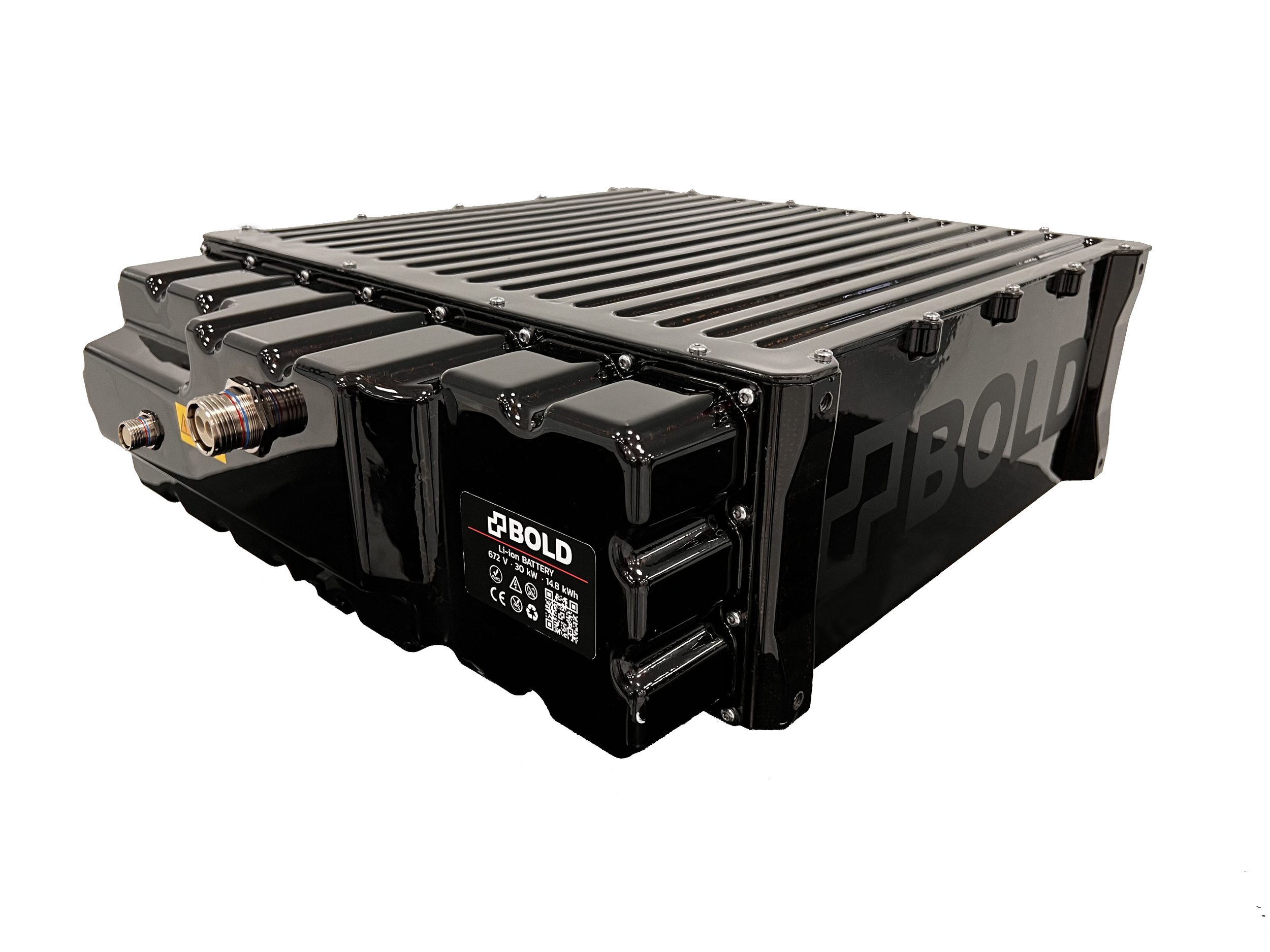
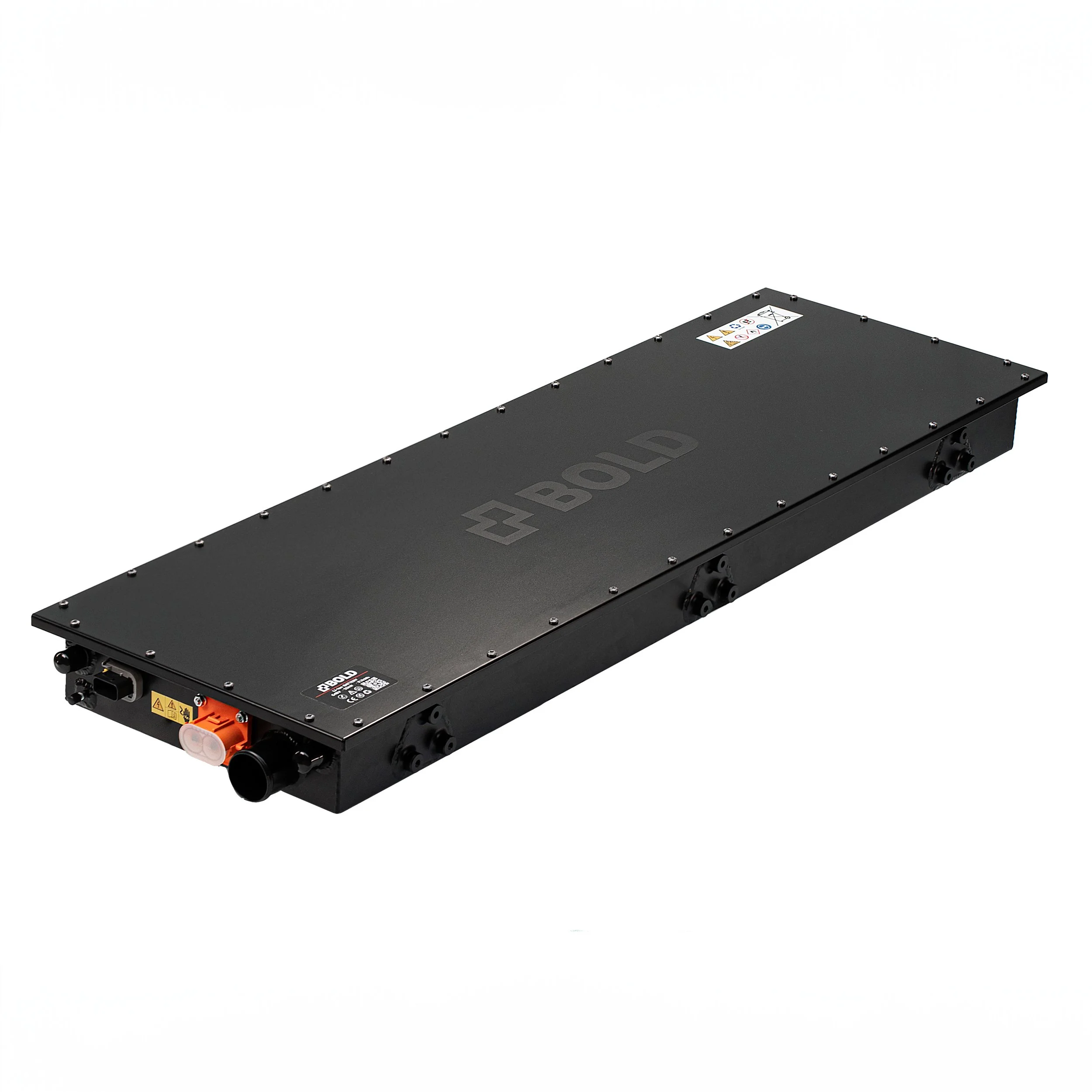
- That's precisely correct, yes. I think one of the decisions that has made this company successful to this day is the approach we have taken. We've tried to be as flexible as possible in our engagement with customers. When it comes to electrification, and batteries specifically, companies normally do not want to spend millions of dollars and a lot of energy developing something when all they want to do right now is not necessarily go into production, but test something on the bench, on a dyno, or on a few aircraft or vehicle prototypes. So here we've had a product approach, where we have developed our own systems. We've got three systems at the moment: Bold HP, Bold Air and Bold HD, with different voltage ranges and different cell chemistries.
- Those are the off-the-shelf solutions.
- These are the off-the-shelf solutions, and again, we fully own the IP. These are products that have a price and a lead time, and they come with an operations manual and a CAN DBC file, so that you can integrate them with the control system of your vehicle. It's meant to be really easy to get these systems integrated into the vehicle. These systems are actually very complex to develop and to come by, but we try to make it very simple and easy for the customer. And then, on the other side, we can either evolve that technology and adapt it to the needs of a specific application or customer, or we can create something completely bespoke, from a clean sheet of requirements, with different thermal management characteristics, different cell chemistries, you name it. We've got the right engineering talent here to develop something very complex from scratch.
- Yeah, I wanted to ask you about the chemistry. Do you guys have a favorite chemistry, or do you specialize in a specific one? Or, as you just said, can you actually work with different approaches?
- We're not married to a specific cell supplier or a specific chemistry, because each application requires different properties and different characteristics from the battery and, ultimately, from the cell. But everything we do is, of course, lithium-ion. We've got some batteries using LFP for some applications, but what we're seeing more and more in the niches where we work and serve our technologies is high nickel content. We are favoring cylindrical cells. We're mostly working with cylindrical cells, some pouch cells in some cases, and a very small amount of our manufacturing goes into battery systems with prismatic cells.
- But you don't make the cells. You integrate them into the pack, right?
- That's right. We are integrators. We don't manufacture the cells. We integrate them into battery packs. What we're doing is taking all the engineering discipline and the F1 engineering methods, that know-how and that way of engineering products, and applying it to batteries, right? So what we end up with are really high-performing battery systems: low weight, really high power, high energy density, and perfect for mission-critical applications.
- Let's look at some numbers. What sort of energy densities are we talking about? And I'm thinking here about the products that are specifically for aerospace.
- We've got a high-voltage product called Bold Air, where we have achieved a gravimetric energy density of 285 watt-hours per kilogram. But we've got other projects where we are targeting higher energy densities than that, so we're talking 300-plus.
- Are we talking at cell level or at pack level?
- At pack level, at high-voltage pack level. Because what we're also seeing is that we're getting more and more programs for drone batteries, and those tend to be a bit simpler and easier to package, so you get much higher energy densities in those cases. But aviation applications require a large number of safety features on the battery system, which adds mass. So getting close to 300 watt-hours per kilo is really challenging. That's what we're seeing.
- Okay, so to recap: 285 to 300 and…
- Yeah, over 300 watt-hours per kilo.
- Okay. And from my understanding, your work has been mostly on drones and manned systems, is that right?
- For aerospace?
- Yeah, for aerospace.
- Specifically for aerospace, we've had a variety of things. We organically and naturally started getting into this sector with a company that no longer exists. It was a lithium-metal cell manufacturer out of California called Cuberg.
- Yes, actually the founder, Richard Wang, has been a guest here on the podcast a couple of times. He left the company after it was acquired by Northvolt, which in turn got into trouble as well. So he's an old friend of this podcast. I think he's now working on other ventures, also in the battery space. I should catch up with him.
- Absolutely. So we started working on some projects with them. Lithium-metal chemistries are very interesting from a performance perspective. They offer really good gravimetric energy densities at cell level, of course, but they also come with some challenges when it comes to safety. And what they found in Bold was the right company to integrate those cells into high-voltage systems and demonstrate that the technology could be integrated into a pack that would be safe and would pass, specifically, DO-311A thermal runaway testing, which is extremely stringent and demanding for the sector, and especially for these types of chemistries, which can be unstable or have safety challenges in some instances. So that's one of the relevant projects that I can speak about. We integrated these cells using lots of carbon fiber and composites, managing really high temperatures of lithium ejecta coming out of the cells when entering thermal runaway. And I think what they got out of it was basically a roadmap to get this product into certification and into production. That's just to give you a taste of the type of projects we have worked on. In terms of the type of aircraft, the batteries we work on range from eVTOL to fixed wing and hybrid, and then some smaller aircraft like drones and things like that. But that gives an indication of the type of applications where we are applying our technology.
- That would be the Bold Air system?
- Bold Air is off the shelf, and it's been used by a lot of customers in these applications. But on many occasions, customers come to us wanting to integrate a specific chemistry into a specific space claim, packaged in a specific way, and those are bespoke developments.
- How do you see the landscape in electric aviation, particularly when it comes to battery development? Of course, that's the cornerstone of the future development of the electric aviation space, and there seems to be a bit of a bottleneck around the 300 watt-hours per kilogram energy density. Some Chinese battery developers talk about going well beyond that. I don't know if that remains a theoretical development, or if it's something you see happening in the near future. What can we expect in the next, let's say, two or three years in the battery space?
- I think a good way to explain it is to think about the product development S-curve. For anyone listening, if you google "product development S-curve", it's basically an S-shaped curve drawn horizontally, and what it shows you is how a technology evolves and improves over time. What we're seeing with batteries is that there have been different types of chemistries that have gone through this, with investment put in to develop and improve the technology. But ultimately, they plateau. They get to a point where the improvement flattens a little, and I think we've seen that in the past with a number of chemistries. We may potentially be seeing it with silicon anode technologies in the very near future. And I think the industry is definitely not getting the energy density it requires to operate with a business case that can be sustained and that can compare with traditional aviation. What I'm seeing is that solid-state cell technologies are coming in, and these will have a much longer development runway, and they will also be evolving really quickly. We're already getting access to some of this technology at Bold. I think these are particularly interesting for aviation, for a number of reasons. One is, of course, that the energy density can be really high.
- If I can stop you for one second here: for those of us who are not experts, what is a solid-state battery? Can you summarize in a few words what's new about this type of battery?
- Yeah. Basically, a cell is made of an anode, a cathode and an electrolyte, and sometimes these cells have a liquid electrolyte and liquid components. In this case, these are cells that have solid elements. This is very innovative technology. It's been done at lab level, at research level, for many, many years, and a lot of people have been talking about it for a long time, but no one could ever see the results of this technology or access it. Also because a lot of startups have been emerging, but large companies have very quickly been acquiring them, which guarantees them exclusive access to the technology and makes it really hard for other industry players to access it at the same time. But it's becoming more accessible. It's becoming very real, and what we're seeing is that these chemistries offer really good energy densities. We are already getting samples at this stage, and they show very good energy density and really good safety parameters. To give you an indication, a regular lithium-ion cell may fail above 150 degrees C and go into thermal runaway, whereas a solid-state cell may fail at over 380 or 400 degrees C. That makes the thermal management challenge a lot less challenging. On the other side, there are still a few things that need to be improved. The cycle life, for example, is still fairly low for this technology.
- What do you mean by that?
- The cycle life is basically how many times you can cycle the cell, a cycle being charging it and discharging it, without losing the performance you need from it, right? It can be at 90% depth of discharge, 80% depth of discharge; there are different ways of measuring it depending on the application. But ultimately, the cycle life is how many times you can cycle the cell without losing its core performance characteristics. We're seeing that this technology still has a relatively low cycle life compared to other chemistries. And aviation is a very specific industry when it comes to the application of batteries, because the regulatory aspect is very stringent, and it must be that way. Of course, safety is paramount. But ultimately, there needs to be a business case for the technology in the industry, and the fact that some aspects of it are not where they need to be makes that hard. That is not to say that there aren't some niche applications where the technology could be applied successfully and where there is a business case. I strongly believe that the technology already has its place today, but there are of course challenges.
- For solid state at the moment, what sort of energy density range are we talking about?
- At cell level, depending on the type of cell, starting from 350 watt-hours per kilo and going all the way up to 500. That's what you can find today.
- Okay, and at pack level, I guess, a bit less, right?
- Yeah, a bit less, yes.
- Pack level is always a bit less because of all the extra systems that need to go into it, right?
- Exactly. To manage…
- The thermal side.
- Exactly, yeah.
- So, would you dare to forecast the sort of energy densities we could be seeing in, let's say, the next three to five years, considering how things are going? Would you dare to do this sort of forward-looking exercise?
- Probably not. It's a very difficult question. But I think in less than five years, and again I'm referring very specifically to high-voltage battery systems for aviation, so not to things like single-use drones, but high-voltage battery systems that have to go through DO-311A, DO-160G, etc., I think we should be getting close to 350 watt-hours per kilo.
- Okay.
- Fairly soon. So that's within the next five years or so.
- Okay. Is there a potential physical limit to how dense this can get with current technology?
- Well, I think ultimately the limit is in the chemistry, right? It's the electrochemistry that goes into it, and I'm probably not the expert in this field to really tell you where the limit is. But ultimately, there's only so much performance a chemistry can achieve from the cell. There's a lot of investment going into these chemistries, and also into solid state, but it's going to get to a point where, bang for buck, it won't give you that much incremental improvement in performance. It's going to flatten at some point. I don't think we are anywhere near seeing a plateau in solid state, for instance, as we are seeing with others. So that would be my answer. I know it's not a very specific answer, but I'm probably not the right person to answer it.
- I guess there's possibly no answer. We're trying to peek into the future in a field that's in constant development. What we could possibly say is that Bold is going to be on top of these developments as they happen. What sort of projects or milestones do you have ahead?
- Yeah, that's a good one. For us, the United States, and North America in general, is a strategic market. We're getting a lot of business out of that region, so we're putting a lot of focus on the States. I am personally traveling over there pretty much on a monthly basis. We've got amazing customers and really good partnerships over there. We currently have an office in Michigan, and we are deploying the investments to manufacture in the States to serve our American customers. So Bold will be manufacturing products not only from Barcelona, Spain, but also from the United States very, very soon, probably as early as 2027. In terms of the sectors that are very important to us, aviation is definitely one. It requires long-term thinking when it comes to cash, patience, the products you have to develop and the relationships you have to build. And where we're seeing strong demand at the moment is, of course, motorsport. That's our bread and butter. That's who we are. It allows us to always be at the forefront of technology and performance, and to develop these technologies extremely quickly. But also, very importantly, defense. We're seeing a lot of missions coming from the defense sector, from Europe and North America. We already have very strong partnerships with General Dynamics, for instance. And I think what's important to mention here is that everything is going hybrid, for a number of reasons. Not only because you can significantly improve fuel efficiency by adding hybridization and batteries to propulsion systems, but also because a lot of new systems are being added to vehicles at the moment to improve their capability. There are new weapon systems and new functionalities being added that require a lot of power and a lot of energy. And more and more, what we're seeing across all applications, with the maturity and adoption of new technologies, is that everything requires a diversity of sources of energy and power, and that's where batteries play a very important role. And I think it's also important that these people need batteries today, right? They don't need batteries in five or 10 years' time. They need batteries today, and they need batteries that are ruggedized, that have demonstrated they work, that are reliable, and that deliver really good performance figures. And that's where, again, we come in. So these are the sectors where we're seeing strong growth. And I think the most important thing about why us specifically is that everything starts with our roots in motorsport, where innovation and development cycles are extremely fast, and you have to be extremely efficient at developing a product and getting it to work. I always say that in the world of Formula One specifically, every year the challenge is the same: you have to deliver a new car that needs to be fast, reliable and drivable, but that also needs to be at a specific place in the world at a specific time of the year. That defines really well what we do, and that's the mindset we're applying to every single sector we're working in.
- Very good. So for people who wish to learn more about Bold, the batteries you're integrating, and your projects, what would be the best resource?
- For those who are interested in Bold, I would of course invite them to visit our website, which is boldtechnology.com. You're going to find a lot of information there about what we do, our products, our customers and our team. And of course, I'm a very approachable person, always happy to talk to and meet new people. I'm on LinkedIn, and very open to people messaging me and chatting. So yes, happy to meet new people.
- Perfect. Well, thank you so much for this very insightful talk about the state of batteries, which is always a topic of interest in aerospace, because so much depends on it. It's just left for me to wish you all the best with all these new projects and with this very promising US expansion, and hopefully we'll coincide soon at some industry event. Thank you so much.
- Absolutely. Thank you, Miquel. Speak soon.
- If you like this podcast, you can support us by giving it a great rating on Apple, Spotify, or whichever platform you get it from. And remember, you can of course subscribe to it, and you can also get regular updates through the Allplane website. That's A-double-L-P-L-A-N-E dot T-V. We have a newsletter where we cover the aviation industry every week, with a special focus on innovation and sustainability. So give it a go. Thank you, and goodbye.
