The Allplane Podcast #136: a new approach to flight tracking, with Alex Lungu (Wingbits)

The popularity of flight tracking apps has transcended the boundaries of the aviation community and truly become mainstream.
I guess most of our readers and listeners are familiar with the market leader in this space, but what if I told you the competitive landscaspe in this space is far from static?
Alex Lungu is the CEO of Wingbits, a ventur capital-backed Swedish startup that is aiming to disrupt the flight tracking industry by introducing a new model to build a flight tracking community which shares differently the value it creates.
It is precisely the way incentives are built into its system that has allowed Wingbits to grow fast in a matter of just over a couple of years, from a few dozen tracking stations when it launched in 2023 to some 6,000 worldwide, as we recorded this conversation.
In this episode of the podcast, Alex will explain what Wingbits is doing differently from its competitors and what factors have allowed this company to grow that fast.
We also discussed, more generally, how flight tracking works and how the huge amounts of data generated by the flight tracking community hold immense value that can be put to good use if the right tools are available.
And this is, precisely, what Wingbits has set to do, because Alex describes Wingbits as, essentially, a data business at its core.
So, tune in for a deep dive into the flight tracking business with our guest today, Alex Lungu, CEO of Wingbits!
Get this episode on:
Things we talk about in this episode
Alex background and how he got interested in flight tracking
How does flight tracking work
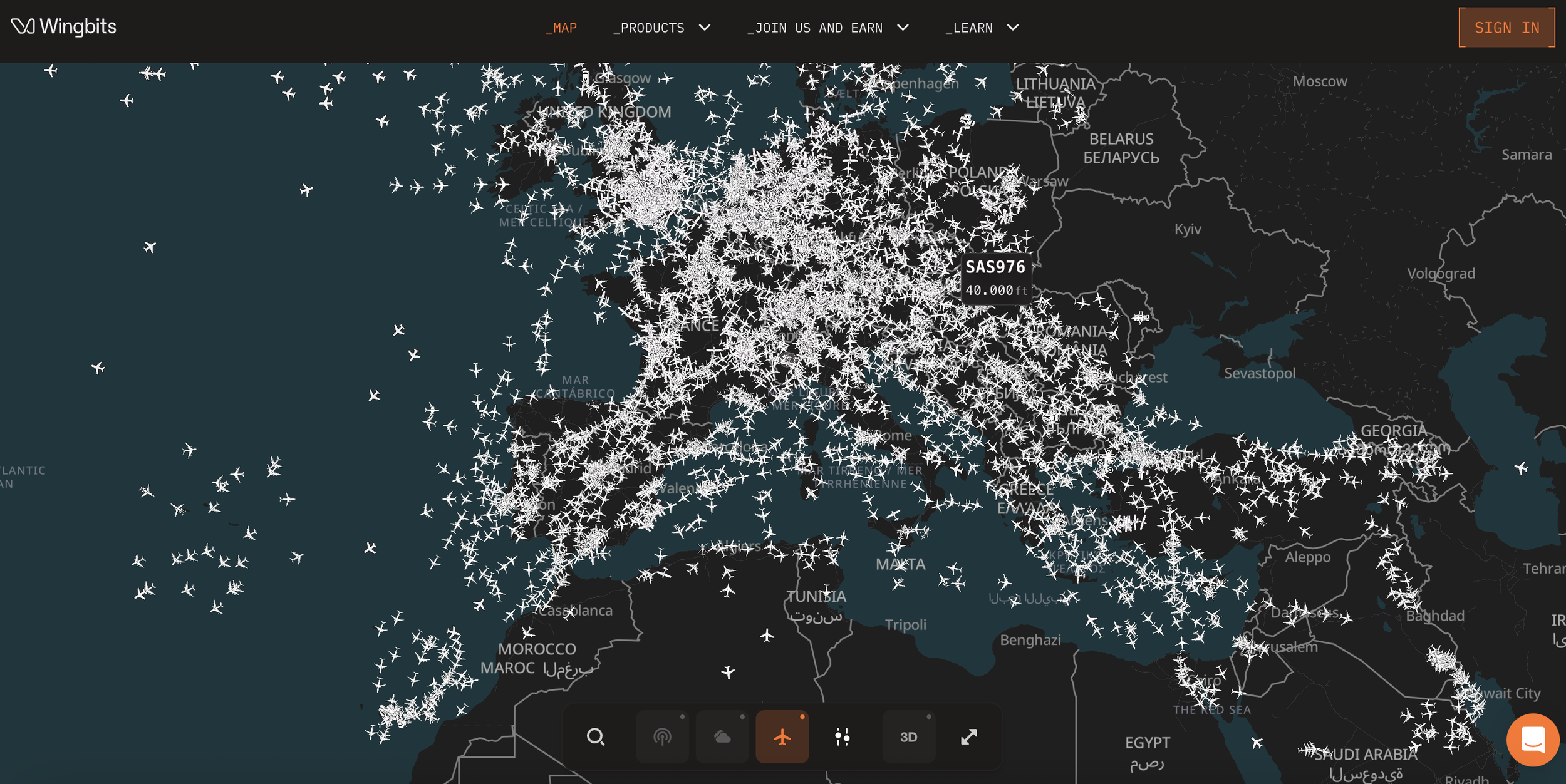
What is Wingbits and what is new about its approach to flight tracking
How does Wingbits plan to break into a market that has long been dominated by a well-established incumbent
The Wingbits geographical expansion and revenue share models
The importance of data for flight tracking app business models
What’s next for Wingbits
Resources
Podcast Music: Five Armies by Kevin MacLeod
Link: https://incompetech.filmmusic.io/song/3762-five-armies
License: http://creativecommons.org/licenses/by/4.0/
Interview Transcript:
(please note that, although we strive to make it as close as possible to the original recording, the transcript may not be 100% accurate)
- Hi, Alex. How are you?
- Hey, Miquel. How are you doing? I'm all good. How are you?
- Very good, thank you so much. It hasn't been long since we last spoke, and it's great to have you here on the podcast today, because we are going to talk about a type of technology that many people use in their daily lives. I would say it transcends the avgeek community, and I'm seeing more and more people from all sorts of backgrounds using it: flight tracking apps and flight tracking technology. You are developing a very interesting project in this field, Wingbits, that I would like to discuss now. But I think it's best if we first start with a short introduction about who you are, what your role at Wingbits is, and how you ended up working in this field.
- Yeah, thanks a lot for having me over. And you are right, this technology is going beyond the avgeeks, because even when I explain to my mom what we're doing, I always have to say that we're like Flightradar24, but different.
- I think it's important to make a comment here. I hadn't mentioned Flightradar24, but it's a very well-known brand, possibly the best-known brand in this space. I think we are going to discuss in more detail how you guys are different from Flightradar24, because there are very significant differences in your approach, and that's a really important part of your story. I think it's good to bring it up early in the conversation, because it's a reference that many people have in mind when they think about flight tracking. Flightradar24 has obviously achieved a very broad market penetration. Pretty much even people who are not into aviation have the Flightradar24 app, and you can see them using it to track flights that a relative or someone close to them is taking, to see whether he or she has arrived, etc. So yeah, good that you brought it up. I think it's a good reference point, and we can continue with your story and how you ended up in flight tracking.
- Yeah, of course, absolutely. It's kind of like saying we're starting a search engine without mentioning Google, right? But anyway, my story is very different from some of your guests'. I listened to some of the episodes to get a little bit inspired about the topics and catch up with the latest, and I would say that we, as a company, are slightly different. We're more of a data company. My background is as a software engineer. Before starting Wingbits, I was an engineering manager at Klarna, so very much not aviation-based. And before that, by education, I'm a telecommunications engineer. I actually studied in Barcelona, which is where I think you're based, right, Miquel?
- Exactly.
- Yeah, I love that city. It's awesome. But yeah, I'm a software engineer, I'm a geek. The story of Wingbits starts with the acquisition of another network about three years ago. I was listening to a tech podcast episode, and they were talking about this drama around flight tracking, because there was a little bit of drama at the time. I really didn't understand it, and it got me super curious about why the community would be upset if a project that they love was being acquired and potentially expanded and grown. So it took me down a rabbit hole. I found flight tracking fascinating, and then I realized that all the flight tracking companies actually operate the same model, which is based on volunteers, on people all around the globe working together to set up stations to track flights for the love of it. I found that super interesting, and sort of inspiring, to describe the feeling. But at the same time, it doesn't sound like a very sustainable business model when you have to rely on people. In the case of that network, what happened is that as soon as the news broke, people simply stopped sending data. They lost 20% of their feeds in about two hours.
- May I interrupt you here for a second? This flight tracking platform that got acquired, we are not talking about Flightradar24. It was a different one, right?
- No, no, no. This is a much smaller one than Flightradar24. Well, I mean, Flightradar24 sold to private equity a few months ago, right?
- True.
- I don't know how that affected them, but yeah.
- That's why I mention it. Sorry, can you please remind us of the name of the platform that got acquired?
- I don't know how much I should talk about other networks. Maybe it's better not to mention them. People can Google it.
- Exactly, they can find the transactions in this space, the one that is not Flightradar24. So I think at this point it's important to dedicate a few minutes to how this tracking works technically. Basically, Flightradar24 and the other platforms work the same way. As you mentioned, they rely on volunteers, people who install a piece of tracking equipment in their homes. It's a bit like an antenna that can pick up the transmissions from the aircraft passing nearby overhead. And then, if you have enough of these points, you can cover a very wide area, right? Can you tell us a bit more? I've just explained it in a very general way, but maybe you can give us a bit more detail so that we understand what we are talking about here.
- I think you've actually done a pretty great job. Aircraft use a protocol called ADS-B to broadcast operational metrics to the world. The intent is to make it much clearer what aircraft are around you in the airspace, and also where you are, where you're heading, how high you are, and the exact location of the aircraft. The aircraft resolves its location using GPS, so it's a much more accurate positioning system than radar, and because of that it has been adopted in a lot of different countries. If I remember correctly, I think both the EU and the US made it mandatory around 2020, and since then we've seen a bunch of other countries adopting it as well. The concept is very simple: the aircraft uses GPS satellites, same as when you use Google Maps to drive. It gets its location that way, and then it broadcasts it on public radio. So anyone could set it up. It does take a little bit of effort, and traditionally it has been more people with an interest in it, but it's not complicated to get up and running.
- And people do it, first of all because of a sense of community, I guess. But they also get some advantages. Not necessarily money: we're talking about things like access to premium data, etc., right?
- Yeah, exactly. The traditional model has always been that you belong to a community of trackers, so you discuss it on Reddit or Discord or forums. But you also get access to the platform without ads, or you get access to the full dataset, which is quite interesting to some people. From a commercial perspective, they always priced the subscription higher than the cost of the hardware, because they want to incentivize people to set up the hardware instead of paying for a subscription, since that's much more valuable. And people do it. But you have no control. You don't know where these volunteers live, right? There could be 1,000 in Barcelona but only one in Stockholm, and those 1,000 people in Barcelona will also send 1,000 copies of the same data. And the benefit is binary. Once you've set up one station, you get access to the platform. Then you don't have any incentive to go out and set up five stations. And if you go on holiday, well, you shut it off, right? You didn't sign any SLAs with the companies. So it's quite a binary and somewhat inefficient model. Also, if you want to grow in a specific area, let's say you don't have a lot of coverage in the Middle East, you will simply have to wait for enthusiasts to come online in that area, or you will have to partner with airports or other companies in that space. So it's not a model that is very easy to grow. And I guess that's where I can say a bit more about how we are different from these models, and how I realized that model was inefficient. The concept we started working with was this. First, we thought it was unfair. Flightradar24 is a Swedish company, for example, and in Sweden the public has access to the financial records for previous years, and we can see that their margins are super high. It's unfair, because you collect this data for free and then you sell it to companies. And it's unfair for the customers as well, right? Because if I sign a contract for two years, assuming I'm going to have data in, I don't know, the Middle East, and the people there decide not to participate anymore, now I'm stuck in a two-year contract and the data is getting worse. So in my mind, the simplest solution was a revenue share. If the company does well, then the community does well. If there is revenue involved, you can set the rules of the game, so you can align the interests of the community with the interests of the company. The company wants coverage, it wants uptime, and it wants redundancy, right?
- But this is the sort of business in which there are network economies. So once a player has managed to reach a certain scale, isn't it quite difficult to get into it? Because basically, the network itself is the moat. The more people there are in the network, the more valuable the network becomes. But at the same time, it also becomes more difficult for another company to replicate it, because it would need to start from scratch.
- Absolutely. You've just told us what many investors told us as well. It is quite hard to get started, especially if you want to operate within the same communities, right? If I go out and try to convince flight enthusiasts that they should also send data to Wingbits, the first question I will get is: okay, but what can you guys give me that the others don't already? I already send data to five other networks. From a flight enthusiast's perspective, the tools that are out there are good enough. They show me what flights are flying around me and the type of aircraft, and I can look at the history. That's most of the value I want out of it. Of course, you can make the argument that some prefer a better UI, and some prefer different ways of looking at the data, but it's quite hard to get into that space. On the upside, once you do, you create this moat, like you said. And that's the reason why, globally in aviation, there are only five or six companies doing this on a global scale, because it's quite hard to get people to participate.
- Both Flightradar24 and you are based in Stockholm, which is curious.
- Yeah, I think their office is about half a kilometer away.
- It's like the world capital of flight tracking.
- Yeah, I think Stockholm is a fascinating place because of that. Somehow it's the AI capital and the flight tracking capital of the world at the same time, and buy now, pay later, and music streaming.
- Yeah, and furniture.
- Yeah, true.
- Sorry, I interrupted you. You were going to explain how your model differs from those of other platforms?
- Yeah, exactly. So we started by trying to make it fair, by doing a revenue share. And once we had settled on that, we obviously started working on what is fair, right? Because just because you set up a station, you shouldn't necessarily get as much as I do. So we started codifying what we call a performance-based model, where, depending on your coverage and your uptime, we quantify and gamify the participation. So we know that my station is better than yours because I have 24/7 uptime and I cover the full 400-kilometer range that I could possibly cover. And we started building on that and adding different bonuses depending on the commercial behavior that we wanted. We knew we wanted more coverage around airports, so we added a bonus for low-altitude coverage. The people who actually capture traffic at ground level at the airport make more than the ones who might only capture planes flying at cruising altitude, because that data is much harder to get, but also harder to predict. If you're at cruising altitude, it's pretty much a straight line, so it's easy to fill in the gaps. While at the airport, it enables us to do a lot more use cases. And what I think is the most contrarian thing we've done compared to the rest of the industry is that we have used the blockchain to enable this on a global scale. Instead of going after the flight enthusiast community, where it would be quite hard to compete for attention, we decided: why don't we build a completely new network from scratch, with completely new people and a new value proposition? We had about 50 stations two years ago, and we're now closing in on 6,000 live stations, and we see that growing this year as well. But like you said, it's still a network model, so we know that we have to grow a lot in the areas where the data is most sought after. So that's the EU, the US, the APAC region, the Middle East, South America. We've been growing quite a lot in the last year, and it's quite cool, in our opinion, that we've actually brought a lot of people into flight tracking who didn't even know about it before, which is quite nice.
- And one aspect that I found particularly interesting is that you have also taken a very unique approach in designing this coverage. If people look at your map, they will see that the whole world is divided into a number of small geographical areas, like little hexagons. The whole map is divided into these small hexagons, and you are aiming to have a station in each of them. Well, obviously not the ones in the middle of the ocean, I guess.
- I'd like those too.
- Well, why not? If someone volunteers to go there and put one there, why not? But otherwise, wherever it's possible, you want one station in each of these equally sized polygons all over the map. So you are not so much looking at having a cluster of 300 people around Stockholm, but maybe 30 people across the whole of Sweden. I'm saying 30, maybe it's 300, I don't know. But it's more of a qualitative approach than a quantitative one. You are focused on getting the right locations to maximize your coverage, rather than having clusters in one specific place and then big empty spaces, so that you have a very spread-out and rationally distributed system, right?
- Exactly. That's a good insight, Miquel. I usually have to explain that one, but that's exactly right. Like I was saying before, there's definitely value in having redundancy, but you do not want 1,000 stations in one city, because that gives you 1,000 copies of the same data, and it costs you time and money to deduplicate it. And that's the reason why we took a very transparent approach to this whole thing. You can go to our map and see exactly where the stations are, and you also see exactly where we don't have them. So if you want coverage in a specific country, you can look at the map, and if it's not there, then you know for sure. What you see on the map is what you get. We don't predict anything, and we don't interpolate. It's only real data. But we also wanted to incentivize people to spread out. So if I live in London, and there are already enough people in London, I can send a station to my mom or my brother. And that helped us spread our coverage really quickly. In the big cities, growth was obviously quite quick, so cities like London, Stockholm and Barcelona filled up quite nicely. But the middle of Spain, or maybe the north of Sweden, are a lot harder to get into. So people started sending stations to their friends and family. We even had cases where people from the US sent them to Africa, for example. That was super cool, and it validated our performance model: if the rules are clear and transparent, people will find a way to maximize their revenue based on them. But if it's not clear and it's opaque, then you don't know what you're competing against.
- And we had another conversation before this call, where you were briefing me a bit on the details of your model. What I also found interesting is that because you are doing this revenue share, companies might be interested in taking part as a business. Not necessarily because they are interested in being part of a community of flight trackers, but because this can bring in revenue by virtue of having these capabilities. So it doesn't need to be an individual. It can be a company. I think you have been doing deals with companies that have networks of locations. It could be a retailer with dozens of stores, who can use those stores, spread out over a wide geographical area, to set up stations and treat that as a line of business that brings in extra revenue.
- 100%. There are three ways of growing for us, right? One is the usual individual setting up one station. Then we have cases like Turkey, for example, where we had an early adopter who bought 50 stations and started deploying them. So they create small local businesses. But we also have very random companies, like you were mentioning. We have a partner that has a chain of Taco Bells in the US. That's real estate, and there's a lot of space on the rooftop where you can easily place a small antenna. But also traffic control cameras, billboards, all sorts of infrastructure that already has electricity and internet. You can easily plug one of our stations in. That has actually helped us quite a bit in growing, because we didn't have to convince one person at a time. Instead, we find the right partners in the right areas and grow faster.
- And physically speaking, what does this station look like? How big is it, what technical requirements does it have, what energy requirements?
- The energy consumption is very low. I think I remember it's about five bucks or something like that, I don't remember exactly. It's a very small computer, about 10 centimeters wide, and then you have an antenna that basically looks like a plastic tube about 60 centimeters high. That's about it, so it's easy to mount.
- So it would be a bit like an internet router with an antenna, kind of?
- Exactly. Ours looks an awful lot like a UFO because it's round, so it's basically a UFO with an antenna in the middle. But we have new partners coming, and it's funny that you mention routers, because the second partner's device will look an awful lot like a router.
- Okay. And do you send it? If someone signs up, do you send the physical device to that person, wherever in the world they are located?
- We have a program now where, as we want to grow in the harder-to-reach areas, we're going to give the stations away for free. But the stations are not ours. We're a data company. So what we've done instead is open-source a hardware specification of how we want the station to look in order to operate on the network, and then we work with third-party manufacturers. They are the ones who build the actual hardware, sell it, and handle the warranties, returns and everything. We don't make any profit on the hardware. We want to make our profit on the data instead.
- Okay, but if I'm somewhere, I don't know, in South Africa or in Bolivia, where do I get it? Do I order it from you and you send it?
- You would order it from the distributors that our partners work with.
- So you would direct me to the closest distributor?
- Yeah, exactly. On our website you have a list of all the distributors, and you can just pick the one in your market.
- And I think it would be interesting to also talk about another thing you are doing. You have these incredible amounts of data, and you are doing stuff with that data as well. You are starting to extract value from it, or create value from it. Can you tell us a bit more about that? What's the long-term plan when it comes to using all the data generated by all these stations you have all over the world?
- Yeah, we have quite a few ideas in our heads. Like I said, we're a data company. We look at this problem from a data perspective, and what we noticed is that the type of service you currently get when you buy data is quite old school. Let's say I want to start a company in aviation. I want to do CO2 accounting or something like that, but only for Sweden. Well, then I have to buy the data raw, process it myself, and spend time understanding raw data that maybe I don't even care about. That's not the value that I provide to my users. And we saw that across the whole vertical. Larger companies, like the Ciriums of the world and Airbus, who already have a data team, don't have a problem ingesting the data, because they've already set up all the infrastructure for it. The problem comes when you are a smaller company that wants to get started. There are no custom solutions for you. You just get the data and figure it out yourself. We have multiple ways of solving that. One of them we're not fully ready to make public yet, but it's going to be super exciting, and we're going to release it pretty soon. Another one is offering, for example, machine-learning-tagged data. When you buy the data from us, you don't just buy it as raw data, but with added metadata. For example, whether it was an unstable approach or not, whether it was too quick, whether it was similar to other approaches to a specific airport, that kind of value. And we also offer people the possibility to query the data directly in our database, which is kind of the obvious way it should work. But as far as I know, nobody else does that, because it removes the power that a two-year contract has, right? So we want to let people access the data a lot more easily.
- What could people be using this data for? Can you give us an example?
- The data feeds into the whole aviation industry in different forms and shapes, right? We have some larger customers, like Spire Global, that consume our data, and Korean Air, which we've also made public, uses our data for its advanced air mobility program. But I think the easier use cases are the smaller companies. We work with a small airline from Maine, for example, that just uses it operationally, to track their planes. We have a company that does turbulence detection. One thing we haven't mentioned is that, because of our model of spreading out the stations and having a much more controlled deployment, our latency is really, really low. Most of the data is under two seconds of latency. At p95, I think it was 1.2 seconds. That enables a lot of use cases that rely on really low-latency data. We have other customers that buy our data to provide an AI tool for city planners to plan drone tests in Oklahoma. That's a super cool use case. So it's very hard to point to one killer use case, including our public map, where you can see all the flights everywhere. Instead, what our customers tend to do is specialize in a particular niche, and then use our data to identify the operational state at a specific time.
- Uh huh. And because they have access to the database, they can customize the type of requests they make and extract the layers of data they need. They might just be interested in a specific data point, a specific region, something like that.
- Exactly. That one is still a pretty new addition. All the previous customers I was talking about are more on the traditional type of ingestion. But we have talked to a few companies where it's exactly like you said. Actually, I guess the airline I was telling you about works that way: I only want to stream data for my particular airplanes. I have nine aircraft in the air, so why would I ingest the whole dataset when I only need those nine? That is something we could do pretty easily. But what we want to enable is, for example, companies that do consultancy in aerospace being able to come in and say: I just need one week of data, one time, for London, under a specific altitude, and so on. And you could do that straight in our database. You don't need to ingest the data or run it yourself. That enables a lot of use cases that are much more about cost per usage, rather than committing to a long-term contract. It's still quite new, and we're still looking for partners there, because we want to find the most common use cases to see where we can enable more value that way. But so far the feedback has been great, because from a customer perspective it gives a lot of freedom. Just use the data when you need it. It's quite an easy value proposition.
- So what's the pricing structure then? Do you charge by the amount of data people consume, or are there other parameters, like whether it's a one-off or someone hooked up to the database for a continuous feed? I guess some people can build their own interfaces and models, and just feed them with the raw data. And are you also able to create packaged data according to a customer's specifications, in more of a consulting role, or is that something you don't do, and you just send the data?
- So, okay, a couple of questions there. When it comes to consultancy, we could definitely do that, depending on the use case, but we run a small team for the operation. And now I'm answering your question about pricing too. We are trying to work out how to price this to make it more standard, because the industry practice is that every single client has to go through a contract negotiation, and it's obscure. Unless you get some public API, which is not the same quality, the pricing for data access has to be pretty obscure. I do understand why now. It was quite frustrating for a while, but I understand that if you buy the data to resell it, the contract obviously needs to look different than for a one-person operation that just needs the data from time to time, right? But we're still trying to find a way of standardizing this, and hopefully at some point create a pricing plan that is more per usage. If you're a heavy user and you plan to resell, you should obviously pay more. If you're a smaller company that only uses the data from time to time, it should be as simple as possible. So I don't have a really good example for you, but for the airline I was talking about before, for example, we're charging per tail, which was much simpler: a fixed fee, regardless of how much data they need. The value they get out of it is knowing where their planes are and where they have been, and keeping a record of that, right? So the pricing should be flexible enough to accommodate that. And yeah, we're developing ways to provide value to our customers with that as well.
- And how does the revenue share with the data providers, the people who run the stations, fit into this model? How do you attribute a certain amount of revenue to each of your contributors?
- It's quite simple, even if it looks a bit complicated on paper. Basically, half of our profit goes back into the community. Initially, we started with blockchain rewards, but lately we've been running a test program that we call the Rewards Hub, where people can redeem airline miles, lounge access, eSIM cards, that type of travel-oriented perk. If you think about it, it's like, I don't know if you use Revolut, where every time you buy something you get Revolut points, and when you accumulate enough points, you can get airline miles. It's the same thing for us. We know that blockchain is a great innovation, but it's quite a polarizing one. It's not for everybody, and that's perfectly fine. So we've evolved into something that we think will be much more appealing to everybody, which is airline miles. You participate in the network, and not only do you get access to the data and to the full platform, but you also get some real-world benefits, which we think is really cool. We do that by using half of the profit to buy packs of miles, packs of lounge access, and so on. Every provider has a slightly different deal, but that's how it works.
- Okay. And where are you now in terms of growth? You mentioned you have some 6,000 stations. What sort of coverage does that give you on a global level?
- Our main presence right now is the EU and the US, and we had a really good growth year in Brazil, the Middle East and Southeast Asia. We want to grow a lot more in Southeast Asia, the Middle East and South America as well, because of that corridor between Asia and Europe that we want to cover end to end. It will be amazing if we get to do that this year. We don't want to get to the point where we have 50,000 stations. The model won't allow it. We want to get to about 10,000 or 12,000, where we will cover most of the world and have a sustainable community as well.
- But how good is your coverage? What percentage of flights are you able to cover on a global basis? I guess, as you mentioned, it might be better in some regions than in others, but do you have any numbers?
- Even in the regions where people might assume the coverage is already top notch, like Europe, for example, the fact that our stations are in different places from our competitors' actually helps us become a great complement in those areas. Some of the best feedback we got was from the larger companies we work with. They don't buy data from a single provider, right? They buy from multiple providers, and what they saw is that we fill in the gaps. For example, Marseille, the Greek islands, Norway: all places where we have stations and the others don't. So we become a great complement to your existing providers. And in other areas, like the Middle East and Brazil, we actually have more coverage than our competitors because of the way our model works. We're also super proud to have stations in some very unexpected locations. I think we have five stations in the West Bank, for example, which is really hard to get into. Simply because the community feels like they belong to a greater good, and they go to extra lengths to make it happen, which is super cool. But we're still looking for partners, and we still need to grow. Compared to Flightradar24, since you brought it up, we estimate our coverage at about 80% to 90% of theirs. When it comes to second-tier and third-tier networks, we're already as good as them, or even better in some areas.
- Is this data access capability also offered by the other networks, or is it unique to your approach?
- As far as I know, it's unique. Usually, you either get access to the data through an API, which is quite limited by credits, with a pricing mechanism that makes it quite hard to predict how much you're going to pay. And then you also have companies like FlightAware, which do have real-time streams, but that is also quite obscure and heavy, from what I understand. That's as far as I know about the competitors. What we're trying to do is go beyond that. We offer access to the data in a way they're not, and I don't think anyone else is doing it. But I don't want to be wrong either. One thing I've learned by being in this industry is that a lot of these networks are competitors on paper, but they sit on top of the same community of flight enthusiasts, right? So there's massive potential for partnerships, for working together, for building something bigger. Because in the end, Flightradar24, FlightAware, all of these networks still depend on volunteers. If the volunteers decide they don't want to do this anymore, all those companies are dead, including ours. We have the benefit of creating a passive income for people, so they have less reason to quit, because they would lose revenue. But we're all communities of people working together. So to me, we can learn a lot from each other, and that's why we're kind of excited that Flightradar24 is so close to us. We're looking at what they did for the industry, but also at how much is left, how much times have changed, and how much potential there is.
- And where are you now in financial terms? I think you are VC-funded, is that right?
- That's correct. We closed our latest round in January last year. We raised nine and a half million dollars. That was our seed round, so we're well capitalized, and our burn rate gives us enough time to reach global coverage, which is really great. But like I said, there are lots of opportunities out there, and it's hard not to get out there and talk about them.
- And you're already monetizing? All these revenue streams you mentioned are already in place, so you're generating cash flow from your network?
- We're still pretty young, and it definitely has a network effect, so last year we focused mostly on growing the network. But even last year, we sent $30,000 to our community in payments on the blockchain, so it can easily be traced and validated. This year, we want to give back much more than that to our community.
- And what's next? What are the next big milestones you are looking forward to?
- I really want to have end-to-end coverage between Europe and Asia. That's something we're working on with partners now. This year our goal is to reach 12,000 stations by the end of the year, and at this rate it looks like that's going to happen. And I'd really love to keep taking new approaches and risks in how we serve our data. It just so happens that, as we record this episode, yesterday we released our 3D map, where you can see all the planes flying in 3D space in real time. It's a small thing, but it's a very geeky thing, and it's very cool to look at. I think you have to have a little bit of fun in this space as well, and with these datasets there are a million things you can find to have fun with. So I really hope we keep doing that during the year.
- And I guess many people might be wondering: how do I become a contributor? What do people need to do to join your community and maybe set up one of these stations?
- I think the best thing is to join the community in the first place, right? If you go to wingbits.com, you will find links to our Discord, where you can interact with the community directly, create an account and register a station. That would be the best. But we also want to grow the community beyond just station providers and feeders. We want people to bring in their expertise in the space and their ideas, so we can build something cool together. So please join the community. There are lots of very fun, interesting people there, and lots of projects already started by the community, which is always super cool to see.
- That's wingbits.com, right?
- Exactly.
- Okay, perfect. Well, thank you so much, Alex, for this very detailed explanation. It sounds like a really cool project, and I'm learning lots of new things here about this world of flight tracking. I must confess, I've been a long-time user, but I never knew that much about what goes on behind the scenes. So the conversation we've had today, and when we first talked, have been a real eye-opener.
- Thank you so much, Miquel, for taking the time and letting me talk, because I can talk about this all day long. Like I said, there's a lot of geek factor in it, and I think that's super appealing to most people. But I would also like to say thanks to you for having such a cool podcast. I've been listening to the episodes since we last talked, and I'm learning so much about the aviation industry, which is super cool.
- Thank you very much. That's very encouraging to hear. It's just left for me to say all the best, and I'm looking forward to seeing how you guys keep growing. I guess there are many cool applications that can be built on top of this data that you are collecting and making available for people to use. So thank you so much, Alex.
- Absolutely. Yeah, thanks a lot.
- If you like this podcast, you can support us by giving it a great rating on Apple, Spotify, or whichever platform you get it from. And remember, you can of course subscribe to it, and you can also get regular updates through the Allplane website. That's A-double-L-P-L-A-N-E dot T-V. We have a newsletter where we cover the aviation industry every week, with a special focus on innovation and sustainability. So give it a go. Thank you, and goodbye.
