Heart’s new aircraft, EU distributes ETS allowances & more
So, here we go! Check out the lastest sustainable aviation round-up, this time covering most of September:
Synhelion heads to Morocco
Synhelion has reached an agreement with the Moroccan government to develop a synthetic fuel plant producing 100,000 tonnes of renewable fuel per year. Read more
It is one of several projects tapping Morocco’s natural advantages for renewable energy production. Another plans to carry electricity all the way to the UK through an undersea cable.
Germany, Austria and Luxembourg put €2.1bn behind e-SAF
Three EU countries have launched a joint initiative to subsidise e-SAF to the tune of €2.1 billion. Strictly speaking, €2 billion comes from Germany, while Austria and Luxembourg put in €60 million each. The scheme sits within the eSAF Early Movers’ Coalition, but the coalition’s other members (Finland, France, the Netherlands, Portugal and Spain) are not part of this particular project.
The money will bridge the expected gap between the e-SAF supply price and the highest bid on the demand side, in a double-sided auction run by an intermediary. Read more
€430m in ETS allowances for SAF users
Greenair News reports that the EU has handed out some 5.2 million EU ETS allowances, worth roughly €430 million ($490m), to 130 airlines as a reward for buying more SAF to meet the ReFuelEU mandates. Low-cost carriers such as Ryanair, easyJet, Eurowings and Vueling were among the largest recipients, because most of their operations fall within the scope of the ETS. Read more
You can also read the European Commission’s official report.
ReFuelEU: so far, so good?
So how is ReFuelEU faring? EASA has published a comprehensive report, and the headline is that SAF supply in the EU exceeded the 2025 target. Read more
Is e-SAF always e-SAF? T&E wants tighter rules
Transport & Environment is among the organisations asking the EU to tighten the rules on what counts as e-SAF. The signatories warn that, as things stand, fuel suppliers could pass off part of the biogenic fuel produced with renewable hydrogen as an input as e-SAF.
This matters. Real e-SAF commands much higher prices, and there is very little production capacity for it, even though it is a core part of the EU’s SAF mandates for years to come. The loophole would let suppliers claim as e-SAF something that isn’t, and over the longer term it could remove the incentive to build genuine e-SAF capacity. Read more
United and Neste extend their SAF deal
United Airlines has renewed its agreement with Finnish energy company Neste, one of the leaders in SAF, to source more fuel at Chicago O’Hare and Amsterdam. Read more
JAL looks at carbon removal
Japan Airlines is exploring carbon removal with Climeworks. Read more
Clean Aviation moves into the demonstration phase
The European Union has selected 19 projects as part of the latest Clean Aviation Joint Undertaking call which will get together €290M in cash from the public purse, although other associated private sector capital allocations in cash or in-kind will bring the total investment in the program to €664M.
The projects cover quite a few different technology stacks, from hydrogen aviation, to hybrid-electric propulsion and many other developments aiming to improve the efficiency of aircraft. The participants include some big industry names, such as Rolls-Royce, Airbus and MTU, but also SMEs and academic institutions. Read more
Contrails: the numbers are getting harder to ignore
There was a lot of activity on contrails and climate this week, with Air France and T&E both publishing reports.
Air France ran a contrail-avoidance experiment from February to April covering 4,300 flights. Of these, 245 were identified as likely contrail creators and 130 were re-routed. The airline estimates this avoided a climate impact equivalent to 22,000 tonnes of CO2. One figure worth keeping in mind: just 3% of flights are responsible for 80% of contrail-related climate impact. Read more
T&E’s findings are striking. Over a 100-year horizon, it puts the benefit of contrail avoidance at between 7% and 23% of global aviation CO2 emissions in 2025, or the equivalent of 10 years of aviation-induced global warming. Read more
If you want to go deeper, listen to our podcast with Maxime Meijers, founder of Estuaire, a French startup that uses data to help airlines avoid forming contrails. Listen here
Heart Aerospace surprises with the ES-36, and JSX orders 100
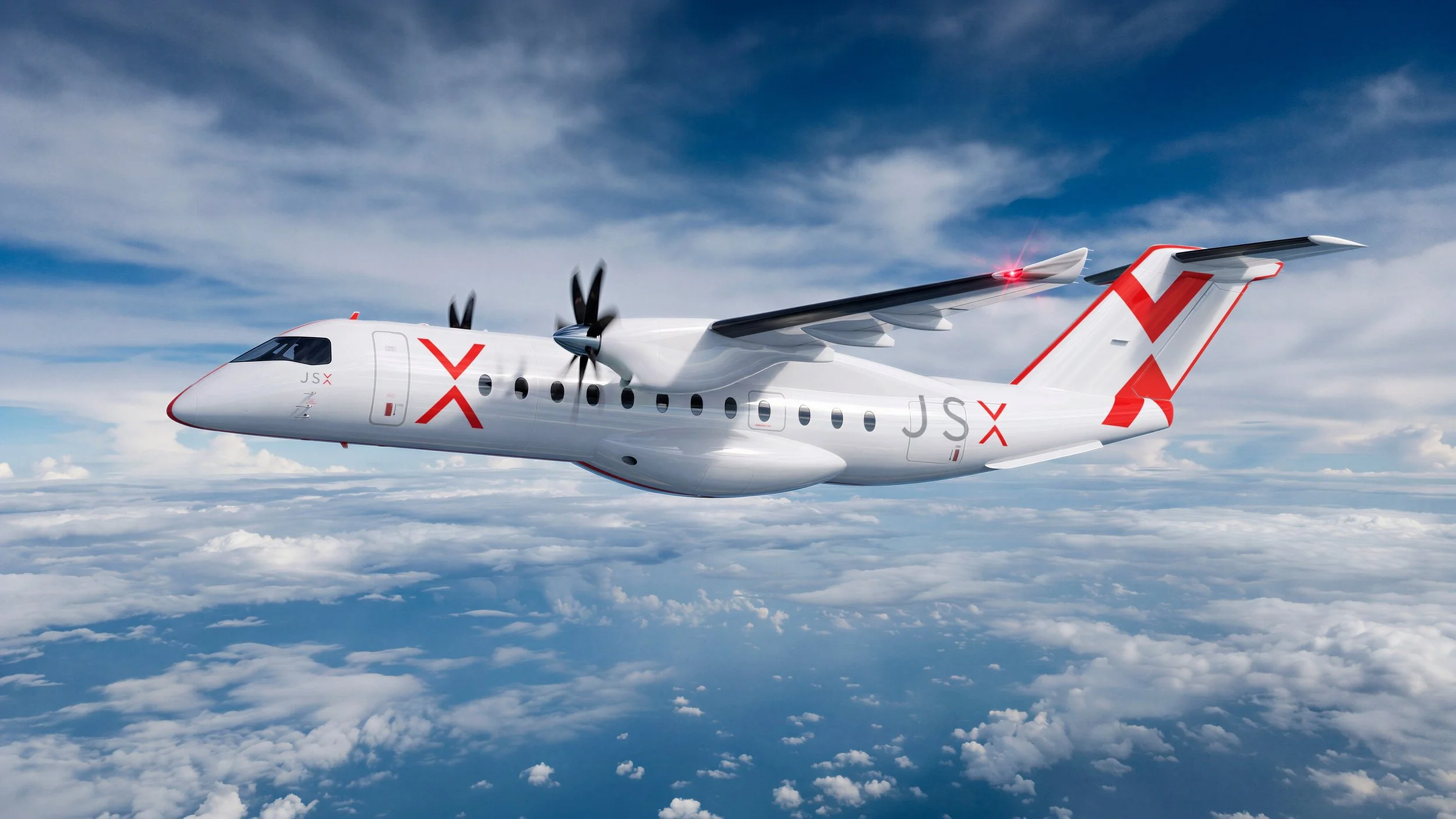
Heart Aerospace took nearly everyone by surprise by announcing a new model, the ES-36, a stretch of the ES-30 with more payload and passenger capacity. JSX has already committed to 50 aircraft, backed by a cash deposit, plus 50 options. Read more
Bye Aerospace’s eFlyer 2 finally flies
Bye Aerospace’s eFlyer 2 electric aircraft has finally made its maiden flights, powered by a magniX Samson300 battery. Read more
Electra: flying like a helicopter, and a partner for the EL9
Electra completed a test flight that worked much like a helicopter operation, taking off from a heliport and following helicopter procedures. Read more
Electra has also selected Atlas, a US engineering firm, to build the EL9 airframes, or more precisely, the ones that will be used in the certification programme. Read more
The X-Volt returns under AURA AERO
The X-Volt, formerly VoltAero’s test aircraft, is flying again, this time for AURA AERO, the French company that acquired VoltAero’s assets a couple of months ago. Read more
To learn more about both companies, see my behind-the-scenes stories on AURA AERO and VoltAero.
Joby flies coast to coast with no one at the controls
Joby completed a coast-to-coast flight across the US in a Cessna Caravan flying fully autonomously. Read more
It’s a remarkable achievement, made possible by technology from XWing, the autonomy startup Joby acquired. We had XWing founder Marc Piette on the podcast just before the acquisition. Listen here
Large drones in European airspace
Eurocontrol has launched a new programme to integrate large drones into European airspace, with Dronamics among the companies helping shape it. Read more
Regent’s Seaglider carries its first pilot
Regent has completed the first human-piloted flight of its Seaglider. Read more
Sceye’s airship crosses the Pacific
US startup Sceye flew its high-altitude airship through the stratosphere to Japan and back, showing the long endurance of this type of aircraft. Sceye pitches the concept as a communications relay platform, a middle ground between ground-based and low-altitude systems on one side and satellites on the other. Read more
Vertical Aerospace: a new chairman and more factory space
Vertical Aerospace has a new Chairman of the Board, no less than a former CEO of Airbus Commercial Aircraft. Read more
It has also opened an expanded production facility in England. Read more
Change at the top at SkyNRG
SkyNRG, one of the major players in SAF, is changing leadership. Maarten van Dijk, who has led the Dutch company since 2009, will step down at the end of the year. Read more
Air Serbia publishes its first sustainability report
One more airline joins the fray: Air Serbia has published its first-ever sustainability report. Read more
