
As sustainable aviation fuel (SAF) emerges as the most feasible option in the short term to decarbonize the bulk of the aviation industry, all over Europe, companies, governments and other stakeholders are scrambling to build up supply. While the aviation industry has managed so far to fulfill the EU's SAF mandates, SAF production remains scarce in Europe and the continent is importing SAF and feedstocks.
Add to that renewed worries about energy security brought about by twin crises in Ukraine-Russia and the Middle East and a sense not just of urgency, but also of opportunity is taking hold.
One of the positive things about SAF is that there are different possible pathways and feedstocks, which opens up the possibility of having a much more decentralized production than with fossil fuels and also to shorten the energy supply chains.
Catalonia, home to one of Europe's busiest airports, Barcelona-El Prat (BCN), as well as several other smaller ones, is one of the places which may benefit from a redrawing of the energy production and distribution map. What's more, in addition to a large existing source of demand, Catalonia also has a major petrochemical cluster in the Tarragona area, which could be partly repurposed to serve this nascent industry if circumstances make it economically or strategically convenient.
So, what is the potential for SAF production in Catalonia?
This is precisely the topic of a study produced by a group of researchers at the Universitat Oberta de Catalunya (UOC) and supported by Vueling, the Barcelona-based carrier of the IAG Group.
Professor Pere Suau-Sánchez and researchers Berta Roset Pérez and Athina Sismanidou, of the Sustainability, Management and Transport Research Group (SUMAT), which is part of the aforementioned university, presented the main findings of this report at a conference in Barcelona on November 3, 2026.
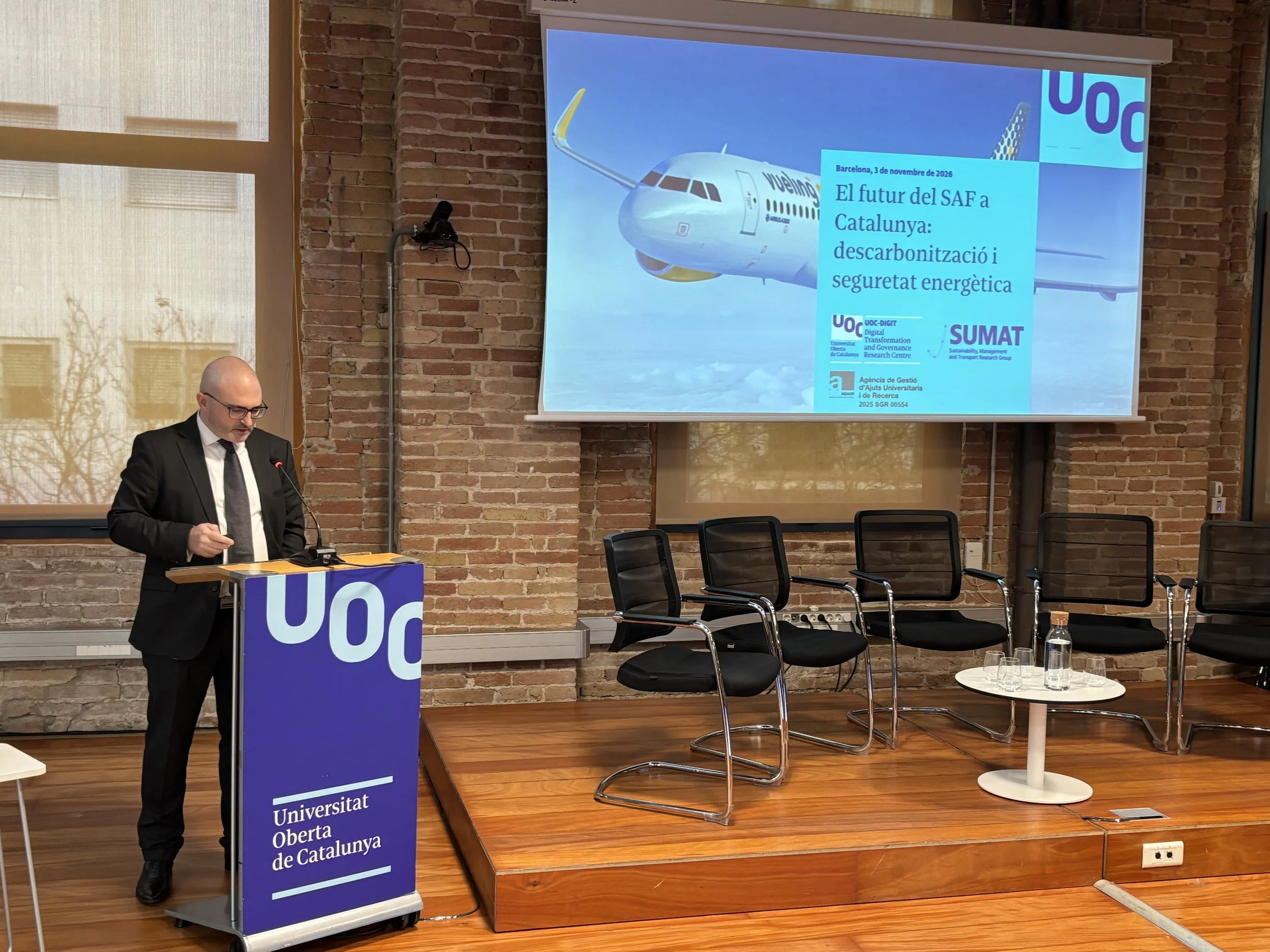
The researchers note that, so far, SAF production is pretty much non-existent in Catalonia and no large projects are planned in the very short term. However, there is still quite a lot of scope to do things in this sphere within the next few years (and decades!)
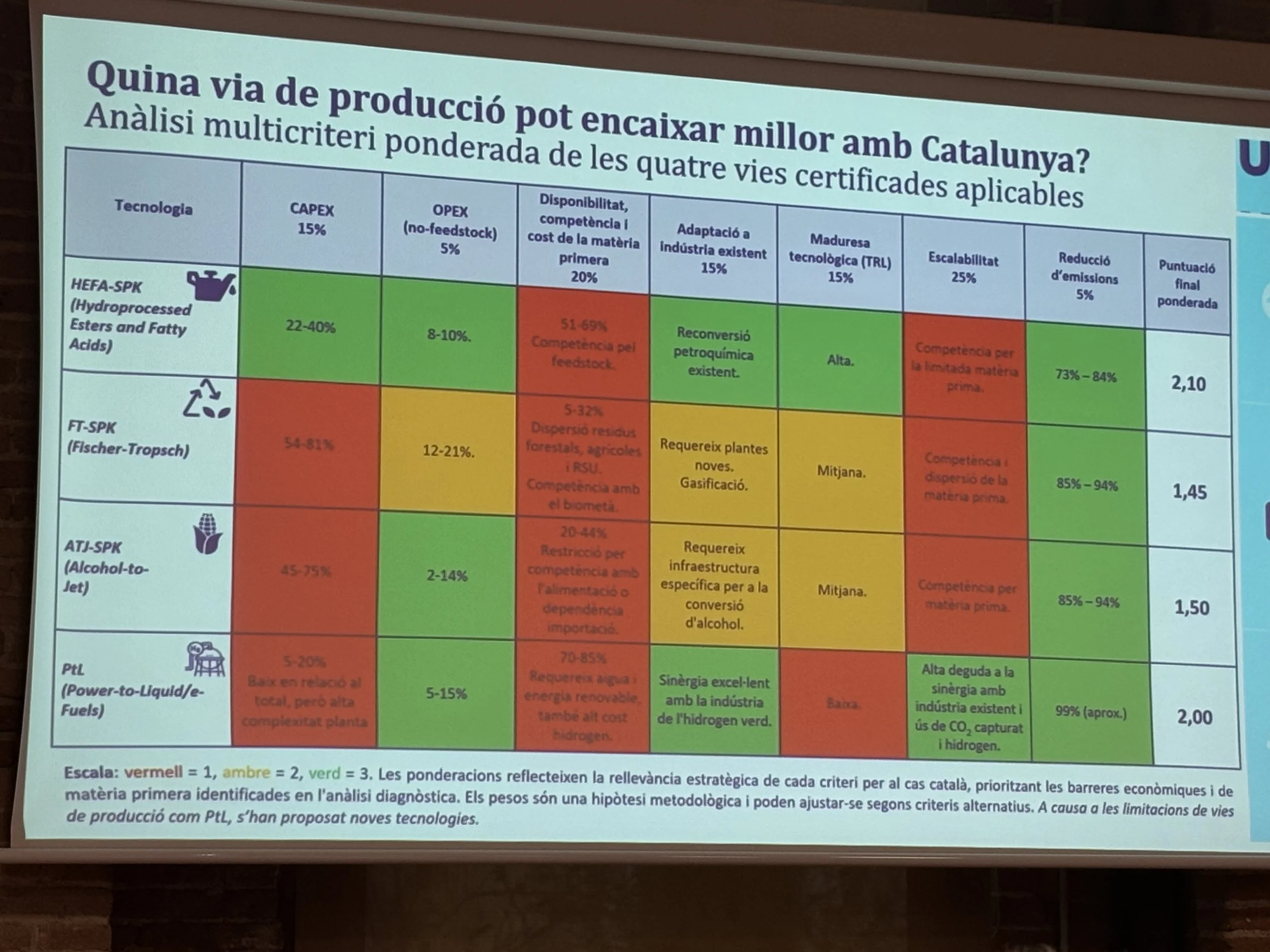
They propose building a Catalan SAF industry in three stages, starting with the more technically mature HEFA technology, which uses waste oils and fats, and moving towards more advanced pathways, with the Tarragona petrochemical cluster expected to play a major role under all scenarios.
For the period up to 2030 the focus would be on HEFA, using the limited amounts of suitable feedstock available. The report breaks down Catalonia's biogenic feedstock by type: 34% agricultural waste products, 49% municipal waste, 10% waste oils and 7% forestry. Only the waste oils can be used for HEFA. The rest would feed the more advanced pathways.
The report then moves on to the period between 2030 and 2040, which is when the researchers foresee some pilot projects using Fischer-Tropsch and alcohol-to-jet processes, which could be fed by agricultural, forestry and municipal waste, along with the first power-to-liquid (PtL) demonstrations.
Forestry residues are particularly interesting in the case of Catalonia, since its forested area has increased significantly as agriculture recedes in many areas. The management and maintenance of this large forested area is a topic that comes up regularly, particularly in years of large forest fires. The issue in this case, I guess, is how this feedstock can be harvested and processed efficiently and economically.
Worth noting also that another feedstock with potential is bio-methane from waste produced by Catalonia's large pig farming industry.
However, according to this report, Power-to-Liquids (PtL) is the SAF technology that presents the most upside in Catalonia and the one with more potential to be scaled up. What’s more, it would be e-SAF, which is mandated by the ReFuelEU framework for use in decades to come but the production of which is still extremely scarce.
However, the PtL roadmap rests on the assumption that there will be enough renewable hydrogen in the Tarragona area to combine with the CO2 which is already produced in the existing industrial processes. The existing petrochemical complex produces and consumes large volumes of hydrogen, but almost all of it is grey hydrogen, made mainly from natural gas and, therefore, not usable for e-SAF. What's more, an initiative called "Catalan Hydrogen Valley" to promote the production of green hydrogen in the area has not really made much progress and its future is a bit uncertain.
It is true that days after the report's presentation, Spanish energy firms Repsol and Enagás Renovable approved a €400 million investment in a new 150MW electrolyser to be built in the Tarragona area. However, its output is in principle intended for a waste-to-methanol plant, not for SAF. And, on top of that, Catalonia still lags far behind in the deployment of renewable energy, an essential ingredient in e-SAF production.
Mechanisms to make things happen
The study also deals with another matter which is not specific to the Catalan case: how to put in place the de-risking mechanisms to make sure operators across the ecosystem invest in the nascent SAF industry. Investors want to see demand and revenue certainty before committing, but buyers are reluctant to commit without having certainty that, come the time, they will get the stuff at competitive prices.
The UOC team points out that Catalonia doesn't need to reinvent the wheel; it would suffice to just combine and adapt a mix of instruments that already exist in Europe, each targeting a specific piece of risk:
Pre-FID (Final Investment Decision) support through schemes such as the EU Innovation Fund, state aid or France's Carb'Aéro programme. This would cover feasibility studies, demonstration and initial capital expenditure, also for FOAK (First-of-a-kind) projects.
Contracts for difference and double-sided auctions to give producers a guaranteed revenue range over the long term and make projects bankable. These systems have been put in place, for example, in the UK and Germany.
A market maker or demand aggregator, which would pool demand from several airlines, standardise contracts and tender long-term volumes. This addresses one of the market's chronic problems: fragmented, short-term buying.
There are also non-financial actions the Catalan government (Generalitat de Catalunya) could take in order to foster the development of a SAF industry. For example, it could start by sending a strong institutional signal of commitment to SAF supply development and set up coordination mechanisms between all the administrations and operators involved. This could help speed up processes on the permit and regulatory side of things. It could even take the form of a Catalan SAF Consortium: a public-private platform bringing together the whole value chain and relevant public organizations. Other European countries such as Germany, Austria, Ireland, Italy and the Netherlands have already drawn up national SAF roadmaps along these lines.
The report is also clear that, even in the most optimistic scenario, local production won't cover all of Catalonia's SAF needs, but the scope and opportunities are certainly significant and the assets are there, in the form of a petrochemical industrial base, some forms of feedstock and logistics infrastructure including ports capable of handling the import and export of feedstocks and fuels.
So there is little excuse not to make it happen!
By the way, if you find this article of interest, you may also like this overview of the aerospace industry in Catalonia.
